

Project Info
Project Description
Soshu Tsunahiro tanto
- Status: Sold
- Kanteisho: Hozon Guarantee
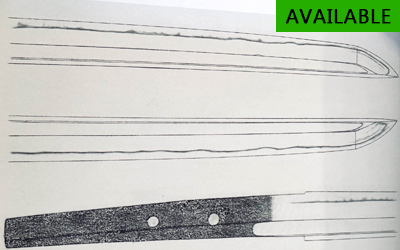
This tantō by the first generation Sōshū Tsunahiro represents one of the most refined survivals of the late Muromachi Sōshū revival, combining exceptional workmanship with a rare and philosophically resonant horimono. The blade is ubu, signed, and dated Tenbun jū hachi-nen (1549), placing it squarely within Tsunahiro’s mature period while he was active in Odawara under the patronage of the Hōjō.
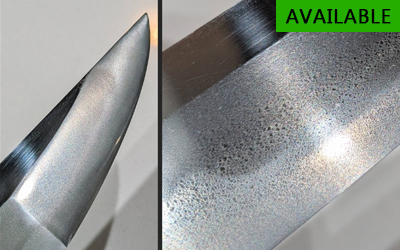
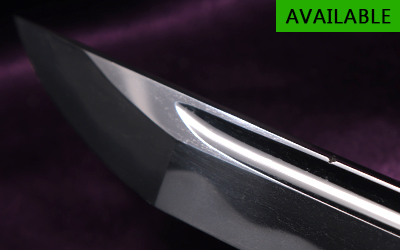
The sugata is that of a well-balanced sunnobi-tantō, with a confident and dignified presence. The jihada is a finely forged ko-itame, dense and even, showing careful consolidation of steel and a quiet, refined surface texture. Ji-nie appears delicately rather than assertively, lending the blade a soft luminosity consistent with the more restrained expression of Sōshū workmanship seen in Tsunahiro’s best works. The hamon is an ito-suguha, controlled and deliberate, executed in nioi-deki with excellent continuity and clarity. This choice of tempering, austere and uncompromising, reinforces the intellectual character of the blade and stands in contrast to the more flamboyant hitatsura often associated with the broader Sōshū tradition.
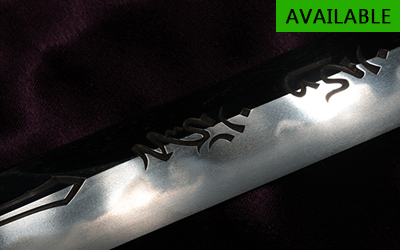
The horimono is of exceptional interest and rarity. Carved with precision and sensitivity, it depicts Kanzan and Jittoku pointing at the moon, a well-known Zen parable that emphasizes the distinction between ultimate truth and its symbolic representations. The figures are rendered with remarkable compositional balance, their gestures directing the viewer’s attention beyond the literal imagery. As with the finest horimono of the period, the carving is not merely decorative but integral to the blade’s conceptual presence, harmonizing with the calm suguha and understated jihada. The moon, left implied rather than overtly rendered, heightens the philosophical intent of the scene.
Tsunahiro, born Masahiro of the Yamamura family, received the character “tsuna” from Hōjō Ujitsuna, marking both a change of name and a formal recognition of his status within the Odawara Sōshū circle. He is regarded as one of the founders of the Odawara-Sōshū group and is traditionally counted by the Yamamura lineage as the eighth generation after Masamune. While clearly informed by classical Sōshū precedents, Tsunahiro’s work reflects a measured evolution of the tradition, favoring compositional discipline and technical control over excess. His dated works from the Tenbun era are particularly valued for their consistency and intellectual clarity.
This blade exemplifies the highest level of Sue-Sōshū workmanship, where material quality, forging skill, tempering discipline, and iconographic intent converge. The combination of an ubu, dated nakago, refined ito-suguha, and a rare Zen horimono places this tantō among the most serious and culturally resonant works of Tsunahiro’s oeuvre, appealing not only as an object of study but as a quiet meditation in steel.
———————————————-
TSUNAHIRO (綱広), 1st gen., Tenbun (天文, 1532-1555), Sagami – “Sōshū-jū Tsunahiro” (相州住綱広), “Sōshū-jū Tsunahiro saku” (相州住綱広作), “Sōshū-jū Masahiro” (相州住正広), “Masahiro” (正広), “Sagami no Kuni-jūnin Masahiro” (相模国住人正広), Yamamura family (山村), he signed first with Masahiro (正広) but received the character for “tsuna” (綱) from Hōjō Ujitsuna (北条氏綱, 1486-1541) who hired him to work in Odawara (小田原) whereupon he changed his name to Tsunahiro, there is the tradition that he was the son of Shimada Yoshisuke (島田義助) and that he was adopted by the 5th gen. Sōshū Hirotsugu (広次), some sources date him even back to the Eishō era (永正, 1504-1521) but from the point of view of extant date signatures (Tenbun 2 to 24 = 1533-1555), this seems a bit too early, he is considered as one of the founders of the Odawara-Sōshū group and the Yamamura family – who claimed descendance from the great Masamune (正宗) – counted him as 8th gen. after Masamune, katana have a wide mihaba, a shallow sakizori, and an elongated kissaki, there are relative many hira-zukuri wakizashi and hira-zukuri ko-wakizashi or sunnobi-tantō respectively extant, they have also a wide mihaba and longer specimen a little sakizori, the jigane is a rather strong itame with ji-nie, the hamon is a hitatsura or gunome-midare but does not show that much nie as classical Sōshū works, i.e. he hardened in nioi-deki or in ko-nie-deki, besides of round tobiyaki also peculiar crescent-shaped tobiyaki appear, the bōshi is a wide midare-komi with a long kaeri or ichimai, many blades show horimono like sō no kurikara, shin no kurikara, bonji over a suken, futasuji-hi, his year of death is unknown but is said to be in the Kōji era (弘治, 1555-1558), posthumous Buddhist name Renkō (連向), ryō-wazamono, jō-saku ◎