

Project Info
Project Description
Bitchu (no) kuni Ko-Aoe Tsuneyoshi
- Status: Reference
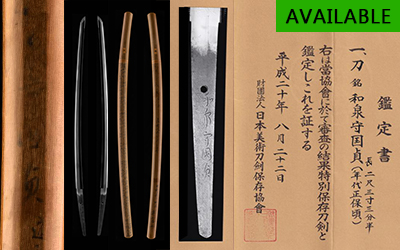
- Kanteisho: Juyo Token
Tsuneyoshi from Bitchū Province
This blade is shortened, but retains a two-character signature. The meikan list a Ko-Aoe Tsuneyoshi as having been active around Bun’ei (1264–1275), and to my knowledge, this is the only work in existence by this smith. Although the signature gives the impression of slightly
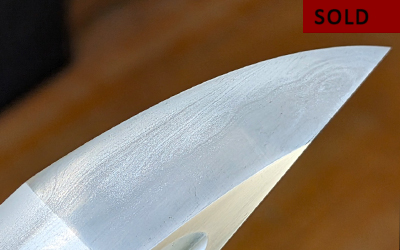
lacking classical elegance, the interpretation of the jiba does suggest that we are facing here a work from a Bitchū-based smith from the late Kamakura period. The kitae is a refined ko-itame that features a midare-utsuri and the hardening is a suguha-chō with a clear nioiguchi and sparkling nie. The ha is mixed with plenty of ashi and yō and displays many areas which have a striped appearance. Thus, this is a masterwork that reflects the refinement and elegance that is associated with the Aoe School.
Blade length ~ 61.5 cm.
Written by Tanzan [Tanobe Michihiro] in spring in the year of the tiger of the Reiwa era (2022) + monogram
- Status: Reference
- Kanteisho: Hozon Guarantee
備中國経義
磨上⼆字有銘⽽銘鑒デハ年代⽂永頃ノ古⻘江ト記セリ経眼本作唯壱⼝デ銘字ニ些カ古朴サヲ⽋ク感アレド地刃ト併セ鎌倉後期同國⼀⼈鍛冶トシテ許容スベキ者ナラン精良ナル⼩板⽬鍛ヘニ乱映⽴チ焼刃ハ直刃調ニ⼩丁⼦ヲ交ヘ⾜・葉繁ク所々縞状ヲ呈シ輝ク沸付キ匂⼝冴ヘ⻘江然トシタル洗練サト品良サヲ⽰ス優品也
刃⻑弐尺⼨参分于時
令和壬寅秊華節探⼭識「花押」
Bitchū no Kuni Tsuneyoshi
Suriage niji-yūmei shikamo meikan de wa nendai Bun’ei goro no Ko-Aoe to kiseri keigan honsaku yuiitsukuchi de meiji ni isasaka koboku-sa o kaku kan aredo jiba to awase Kamakura-kōki dōkoku ichinin kaji to shite kyoyō-subeki mono naran. Seiryō naru ko-itame kitae ni midare-utsuri tachi yakiba wa suguha-chō ni ko-chōji o majie ashi, yō shigeku tokorodokoro shima-jō o tei-shi azayaku nie-tsuki nioiguchi sae Aoe-zen to shitaru senren-sa to hin’yoku-sa o shimesu yūhin nari.
Hachō ni-shaku sun san-bu toki ni
Reiwa mizunoe-toradoshi kasetsu Tanzan shirusu + kaō
Jūyō-Tōken at the 68th Jūyō Shinsa from November 2, 2022
Tachi, mei: Tsuneyoshi (経義) (Ko-Aoe, 古⻘江)
Measurements
Nagasa 61.6 cm, sori 1.2 cm, motohaba 2.4 cm, sakihaba 1.65 cm, kissaki-nagasa 2.4 cm, nakago-nagasa 18.25 cm, nakago-sori 0.2 cm
Description
Keijō: shinogi-zukuri, iori-mune, slender mihaba, no noticeabler taper, normal kasane, relatively noticeable sori, chū-kissaki
Kitae: densely forged ko-itame that features penty of ji-nie, a little bit of chikei, a midare-utsuri, and some suji-utsuri in places, resulting thus in a dan-utsuri
Hamon: suguha-chō in nie-deki with a bright and clear nioiguchi that is mixed with ko-gunome, kochōji, many ashi and yõ, some connected elements in places that tend to have a linear appearance, and a hint of hotsure
Bōshi: sugu with a late starting and pointed maru-like kaeri
Horimono: on the omote side a futasuji-ji and on the ura side a bōhi, buth running as kaki-nagashi into the nakago
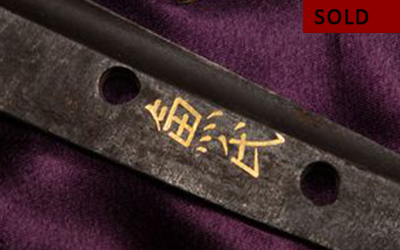
Nakago: suriage, ha-agari-kurijiri, the original yasurime are indiscernible due to corrosion, the new yasurime are sujikai, five mekugi-ana, the haki-omote side bears centrally below of the fourth mekugi-ana a large niji-mei
Explanation
It is said that the Aoe (⻘江) School of Bitchū province was founded by the smith Yasutsugu (安次) around Shōan (承安, 1171-1174). The school flourished up to the late Nanbokuchō period and gave rise to many great master smiths. Blades made up to the middle of the Kamakura period are referred to as Ko-Aoe (古⻘江), “early Aoe.” The workmanship of the Ko-Aoe group features a rather standing-out mokume that appears as chirimen-hada, and many of their blades feature jifu. The hamon is usually a nie-laden and calm suguha-chō, which may be mixed with some ko-midare, and which is therefore of a somewhat more sober taste than most of the contemporary Bizen hamon. Representative Ko-Aoe smiths were Moritsugu (守次), Tametsugu (為次), Tsuguie (次家), Tsugutada (次忠), Sadatsugu (貞次), Yasutsugu (康次), Kanetsugu (包次), Tsunetsugu (恒次), and Toshitsugu (俊次), which demonstrates that most o them shared the character for tsugu (次). Also, Ko-Aoe smiths usually signed on the haki-ura side and finished their tangs with ō-sujikai yasurime, which distinguishes them from Ko-Bizen and other smiths from that time period. This tachi has a slender mihaba, does not taper much, has a relatively noticeable sori, and a chūkissaki. The kitae is a densely forged ko-itame that features plenty of ji-nie, chikei, and a midare-utsuri, also becoming a dan-utsuri in places. The hamon is a suguha-chō in nie-deki that is mixed with kogunome, ko-chōji, many ashi and yō, and with a few hotsure. With the densely and finely forged koitame that is of a “wet” appearance, the midare-utsuri and suji-utsuri that become a dan-utsuri, and the elegant suguha with its bright and clear nioiguchi, the blade is overall of a refined interpretation. In addition, the abundance of ashi and yō within the ha, and the linear appearance of some of the elements of the ha create much variety and are very attractive. Also, the blade is featured in the Kōzan Oshigata (光⼭押形).