

Project Info
Project Description
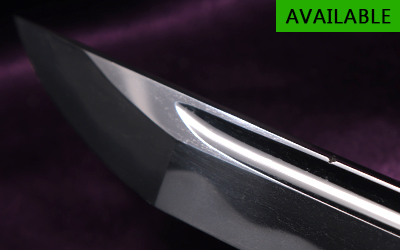
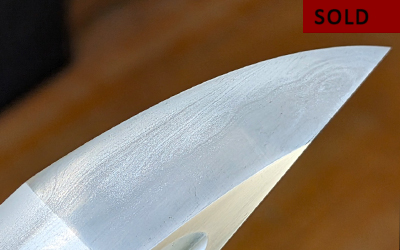
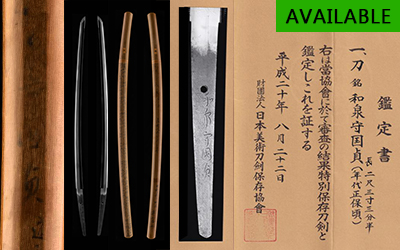
Soshu Sadamune tanto
- Status: Reference
- Kanteisho: Tokubetsu Hozon
- Provenance: George Yang
SADAMUNE (貞宗), Kenmu (建武, 1334-1338), Sagami – “Sagami no Kuni-jū Sadamune” (相模国住貞宗), he came according to tradition originaly from Ōmi province and bore the first name Hikoshirō (彦四郎), he went to Kamakura where he became the student and later the adopted son of Masamune (正宗), he is not listed as one of the “Ten Students Masamune,” probably because he was as mentioned his son or successor, even if he followed Masamune´s style closest from all the smiths on the Ten Students list, in old sword documents we find oshigata of signed blades with date signatures from the Kagen (嘉元, 1303-1306) to the Jōwa era (貞和, 1345-1350), today no zaimei work exists which could be definitely attributed to him, the earliest extant work attributed to him is the kokuhō Kikkō-Sadamune (亀甲貞宗), on the basis of extant blades like tachi, tantō, and ko-wakizashi we are able to determine his active period from the end of the Kamakura period – around Karyaku (嘉暦, 1326-1329) and Gentoku (元徳, 1329-1331) – until about the Nanbokuchō-period Jōwa era (貞和, 1345-1350), there exist some late-Kamakura-period smaller tantō but most of his tantō are sunnobi and measure about 28.8 cm or are ko-wakizashi measuring somewhat more than 1 shaku (30.3 cm), also most of the tachi attributed to him have a wide mihaba and an elongated kissaki, that all speaks for the Nanbokuchō period as his prime, the jigane is a standing-out itame with plenty of ji-nie but can also show mixed-in mokume, always strong chikei are seen, the hamon is a notare mixed with ko-midare or an ō-midare in nie-deki with a wide nioiguchi, in addition many vivid kinsuji, inazuma, and sunagashi are found, altogether Sadamune´s blades are a little more calm than that of Masamune, the bōshi is a notare-komi or midare-komi with a pointed, a ko-maru, or an ō-maru kaeri, always with much nie and hakikake, as for horimono, we find mostly bonji and a suken or futasuji-hi but also suken as a relief in a hi or koshibi are known, it is said that he was the fist smith who cut a futasuji-ji on a katakiriba-zukuri blade, the famous ko-wakizashi Tokuzen´in-Sadamune (徳善院貞宗) which was once owned by Maeda Gen´i (前田玄以, 1539-1602) shows Sadamune´s typical jihada but the hamon is an ō-midare which tends to hitatsura and is not seen on any other work of this smith, however, the excellence of the nie and the quality of the jigane is clearly superior than that of later Sōshū-smiths like Hiromitsu (広光) and Akihiro (秋広) and the interpretation of the horimono in the form of a bonji and a suken is also similar to Sadamune, therefore there is no doubt that it is an authentic work of Sadamune even if it shows an uncommon hamon for this smith, like at Masamune there is also a list of some of Sadamune students, the “Three Students of Sadamune” (Sadamune no santetsu, 貞宗三哲), who were Yamashiro Nobukuni (信国), Hōjōji Kunimitsu (法城寺国光), and Bizen Motoshige (元重) ⦿