

Project Info
Project Description
Naoe Shizu katana
- Status: Sold
- Kanteisho: Tokubetsu Hozon
Aside from Sadamune, I believe Shizu, Samonji, and this Go [Yoshihiro] should form the top three among the ten [of Masamune’s disciples]. — Dr. Honma Junji
Shizu Saburo Kaneuji is a grand master swordsmith working from the end of the Kamakura period into the beginning of the Nanbokucho period. He was highly influential, and is the founder of the Mino tradition – one of the five general koto styles of swordsmithing. His path through life lead him from his beginnings in Yamato as a Tegai smith most likely working under Kanenaga, to tutelage under Masamune in Kamakura around 1319. He finally settled in the Shizu area of Mino province at the beginning of the Nanbokucho period. The mastery of the Soshu and Yamato traditions merged in his teachings to become the Mino tradition.
Kaneuji started by signing his name with these characters: 包氏. The first character, for Kane, is commonly found in Yamato smiths and was handed down through the students he left behind when he moved to Kamakura. On his arrival to be taught by Masamune, he changed his signature to 兼氏 which was still read as Kaneuji. He has work signed like this that still is in Yamato tradition, showing that he may have come to produce in Kamakura and then learned from Masamune as a secondary effect of being fellow residents. After Kamakura, he moved to Shizu in Mino province, and he is now generally referred to with the nickname Shizu as a result of his final place of work.
Swords from his time period in Yamato are referred to as Yamato Shizu because of the nickname we use for him today. His work after his learning with Masamune are simply referred to as Shizu. This however makes for some points of confusion, because the students he left behind in Yamato are also collectively referred to as Yamato Shizu and there was also a nidai Kaneuji who left behind some excellent works in Yamato. Context is then necessary whenever examining a blade attributed to Yamato Shizu to determine if it is a school or individual attribution.
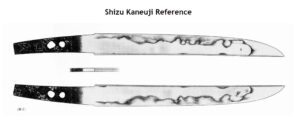
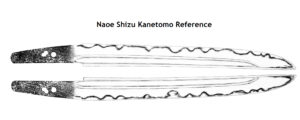
The students Shizu Kaneuji left behind in Mino when he died are called Naoe Shizu, as they moved and settled in Naoe which was a village in the northern part of Shizu. These Naoe Shizu smiths are known individually as Kanetsugu, Kanenobu, Kanetomo, and Kanetoshi and may also have been sons of his. Since they typically made Nanbokucho style sugata that have been cut down with signatures lost, they were particularly subject to losing their signatures. Today, there are no signed tachi left by the Naoe Shizu group. This leads to the frequent use of the school classification when attributing to them, but we know the work styles and the smiths by signed tanto and ko-wakizashi.
Kaneuji is famous today for being the student of Masamune who’s work was closest in style to the master. We can confirm through dated works that were recorded in the Edo period that his dates align with the historical production of Masamune. Masamune of course is hailed as the greatest of the Soshu smiths and is usually considered the greatest smith of all time.
Of the Naoe Shizu smiths, there is a nidai Kaneuji, and a sandai Kaneuji. The smith Kanetsugu among the Naoe Shizu smiths is said to be the son of Kaneuji, and it is possible that he is also the nidai Kaneuji. The style of the Naoe Shizu smiths is generally similar to Shizu but a level lower in quality, and those at the topmost level of quality may be thought to be works of Kaneuji now, it is difficult to tell in some cases.
The school smiths have very few signed blades compared with Shizu Saburo Kaneuji. Today, there is no tachi known with this signature, and only wakizashi and tanto are seen with this signature. Kanetsugu has one Juyo Bijutsuhin tanto beside this one, and Kanenobu has two Juyo Token tanto. Generally, no later than the Nanbokucho time, Kaneuji hamon mostly have a large pattern, and sometimes ko-gunome styles are seen. With either style, one does not see a whitish jihada, and there are strong nie on the ji and ha.
Kanetsugu, Kanetomo, and Kanenobu’s Naoe Shizu smiths hamon have smaller patterns and a somewhat whitish jihada when compared to Kaneuji’s work, but Kanetsugu’s work shows swords with both styles: a whitish jihada and with no whitish jihada. This wakizashi [by Naoe Shizu Kanetsugu] is a large size with somewhat large pattern gunome, and the jihada is not whitish. The ji and ha are clear, the glamorous boshi is a midare hamon and appears like a like a flame, and blade is full of spirit, and this is the O-Shizu style, and this is valuable information showing us that already in Kanno times (1350), this kind of shape has appeared. — NBTHK Token Bijutsu
Today Shizu’s swords rank from Juyo (of which he has 130, placing #6 overall in the list of makers) and Tokubetsu Juyo (of which he has 14). He also has works ranked Juyo Bijutsuhin and Juyo Bunkazai. He is of course regarded by Fujishiro as Sai-jo Saku, the rating of a grandmaster swordsmith.
The Naoe Shizu works that have been ranked at Juyo by the NBTHK number 157. Of these only 7 are signed, which illustrates one of the problems left to us in differentiating the Naoe Shizu smiths. On top of the Juyo there are another four Juyo Bijutsuhin, with two by Kanetomo, one by Kanetsugu, and one unsigned and attributed to the school.