

Project Info
Project Description
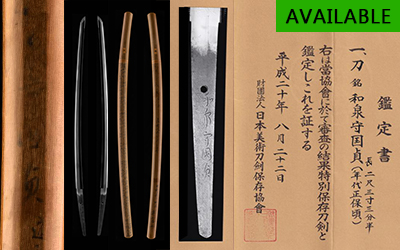
Juyo Token Naoe Shizu katana
- Status: Available
- Kanteisho: Juyo Token
Jūyō-Tōken, 44th Session — Designated November 12, 1998
Katana, mumei: Naoe Shizu (直江志津)
Kagoshima — Kojima Masaharu (小島正治)
Measurements
Nagasa 69.5 cm, sori 1.7 cm, motohaba 3.0 cm, sakihaba 2.4 cm, kissaki-nagasa 4.6 cm, nakago-nagasa 17.5 cm, nakago-sori 0.1 cm
Description
Keijō: shinogi-zukuri, iori-mune; wide mihaba with little difference between base and tip; despite being greatly shortened (ō-suriage), the curvature is relatively high; ō-kissaki.
Kitae: itame-hada with a flowing tendency (nagare-gokoro) intermingled; thickly formed ji-nie with chikei.
Hamon: Small notare-toned with gunome mixed in; the nioi is deep, nie adheres well, with sunagashi and kinsuji, and yubashiri appearing; the nioiguchi is bright and clear (saeru).
Bōshi: Gently notare and turns back in ko-maru.
Horimono: On both sides, a bō-hi carved through (kaki-tōshi).
Nakago: Greatly shortened (ō-suriage), tip cut (sakikiri); file marks are sujikai; two mekugi-ana, one plugged; unsigned.
Era
Nanbokuchō period
Explanation
In the Shizu region of Mino Province, Kaneshibu (兼氏)—counted among Masamune’s so-called “Ten Disciples”—came and settled, and his line flourished. Later, however, his pupils Kanetomo, Kanetsugu, Kaneshige, Kanenobu, and others moved to Naoe in the same province and forged there. For this reason, the swordsmiths of this lineage are generally referred to as “Naoe Shizu.”
This sword is greatly shortened and unsigned; nevertheless, the jihada and hamon are richly covered with nie, and it shows a flowing-tinged itame forging with chikei. The temper is a calm, gentle interpretation in small notare mixed with gunome, displaying such activities as sunagashi, kinsuji, and yubashiri. The bōshi is gently notare and returns in ko-maru. Taken as a whole, it manifests a composed and unperturbed air, and is a typical example of Naoe Shizu; moreover, both ji and ha are clear (saeru) and in kenzen (sound and well-preserved) condition.