

Project Info
Project Description
Juyo So-den Bizen Kencho katana
- Status: Sold
- Kanteisho: Juyo Token
Osafune Kanenaga (Kencho) from Bizen province
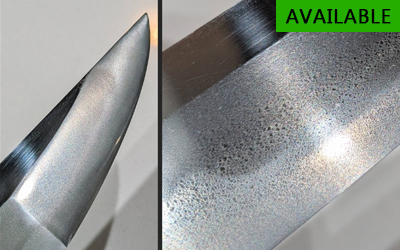
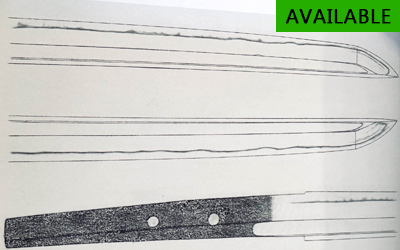
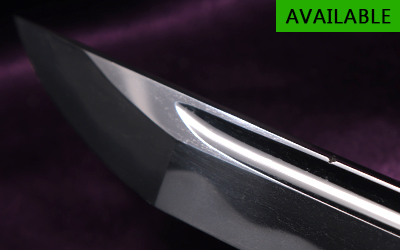
This blade is ō-suriage mumei. With its wide mihaba and ō-kissaki, it is of a magnificent and powerful Enbun-Jōji shape, and with its hardening in yamagata-gunome-midare in nie-deki, it clearly reflects the typical Sōden-Bizen style of the Chōgi group. Taking into consideration the relatively calm course of the ha and the fact that it is composed of small dimensioned, complex midare elements, this masterwork can be narrowed down to Kenchō.
Blade length ~ 70.9 cm
Examined and written by Tanzan [Tanobe Michihiro] in February in the year of the dragon of this era (2024) + monogram.
—-
Juyo Setsu-mei
It is said that Kenchō (兼⻑), whose name is also read Kanenaga, was a student of Chōgi (⻑義). Existing signed blades of his are extremely rare. There is a Jūyō-Bijutsuhin wakizashi dated Jōji five (貞治, 1366), e.g., which is hardened in a hitatsuralike hamon. Apart from that, there exists a Jūyō tantō dated Shitoku four (⾄徳, 1387) (17th Jūyō Shinsa) and a Tokubetsu-Juyō tantō dated Kakyō two (嘉慶, 1388) (4th Tokubetsu-Jūyō Shnsa). The aforementioned wakizashi is very nie-laden and its jiba displays an abundance of hataraki, which makes it come close to the workmanship of Chōgi, but whose deki emphasizes even more the Sōshū tradition than seen with his alleged master. Almost all katana by Kenchō in existence are mumei and attributed to this smith. Again, their interpretation is similar to Chōgi, but with more nie and with plenty of hataraki within the ha, and most of them display a relatively large dimensioned midare that is occasionally mixed with some chōji.
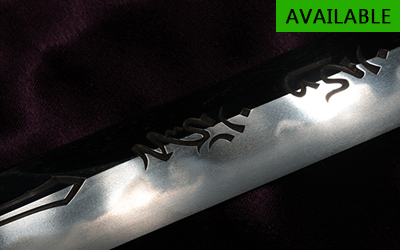
This blade has a wide mihaba, a shallow sori, an ō-kissaki, and is of a powerful shape that dates it to the Nanbokuchō period, particularly around Enbun (延⽂, 1356–1361) and Jōji (貞治, 1362–1368). The kitae is a standing-out itame that is mixed with nagare and that features plenty of ji-nie and a faint midare-utsuri. The hamon is a nie-laden chōji that is mixed with togariba, gunome, ko-gunome, some smaller dimensioned and complex midare elements in places, and with many ashiand yō. Thus, within the Chōgi group, the blade most prominently reflects the typical characteristics of Kenchō, hence we are in agreement attributing it to this smith. With its magnificent shape featuring a wide mihaba and an ō-kissaki, its hamon being rich in variety and its emphasis on nie that spill into the ji in many places, and the yaki-kuzure bōshi, wwe have here a masterwork, whose jiba powerfully embodies the Sōden-Bizen approach.
KANENAGA (兼長), Jōji (貞治, 1362-1368), Bizen – “Bishū Osafune-jū Kanenaga” (備州長船住兼長), according to tradition the son of Nagashige (長重), another tradition says that he was the son of Kaneshige (兼重), there exists also a two-generations theory about that Kanenaga, that means that a 2nd gen. was active from about Shitoku (至徳, 1384-1387) onwards, Kanenaga – whose name is sometimes also quoted with the Sino-Japanese reading Kenchō – was supposedly a student of Chōgi (長義) (the two-generations theory says that it was the 2nd gen. who studied under Chōgi), most of the ō-suriage-mumei blades attributed to Kanenaga show a flamboyant gunome-chōji in ko-nie-deki but there exists a signed hira-zukuri ko-wakizashi with the date signature of the fifth year Jōji (1366) which shows a different interpretation and reminds with its hitatsura of the Sōshū tradition, that means from the point of view of active period and workmanship (=Sōden-Bizen) is is possible that there was just one generation Kanenaga but who varied his style, the Ōseki Shō (往昔抄) mentions that Kanenaga worked until Meitoku (明徳, 1390-1394) which in turn would support the two-generations theory, ō-wazamono, jō-saku
———————————————————————–
Article below courtesy of Darcy Brockbank.
The Osafune group in Bizen province represents the longest running school of swordsmiths, with the most talent, out of all schools and traditions. The main line of Osafune is founded by Mitsutada in the middle of the Kamakura period, around 1250. He and his son Nagamitsu, his grandson Kagemitsu, and his great grandson Kanemitsu, represent the top ranking four smith lineage in history… when they look to the side the only line that they can see as a peer is Awataguchi from Kunitomo, to Norikuni, Kuniyoshi and Yoshimitsu.
At the end of the Kamakura period, in Yamashiro province the Rai school rose to eminence and around this time Shintogo Kunimitsu in Sagami province made the first Soshu tradition blade. It is a tanto known as the Midare Shintogo and set the bar very high as it broke new ground in the development of the Japanese sword. The Soshu tradition would rise and through Yukimitsu, Norishige and Masamune, become very popular with the warrior elite in Kamakura. With the passing of Masamune, this style of sword making was expanded and transformed by Sadamune, Hiromitsu and Akihiro. During their time the country was at war between the Northern and Southern Courts, and most of the long swords made directly in Kamakura were destroyed.
The popularity of the Soshu tradition at this time caused a migration of smiths to come to Kamakura, and learn Soshu techniques, and take them home again or else find a new home and bring the Soshu tradition along with them. Smiths like Kaneuji and maybe Kinju came from Yamato and then took Soshu tradition techniques to Mino province. Norishige departed Kamakura for his home in Etchu and made Soshu works there. Hasebe Kunishige brought Soshu tradition works to Kyoto in Yamashiro and the school he founded was popular and dominant. Long off into the Muromachi period, Hasebe’s work was handed down to the famous smith Muramasa who made some hitatsura blades with these techniques. Sadamune himself eventually left Kamakura and took up residence in Takagi, and his son kept the Sadamune name alive (today he is known as Takagi Sadamune). Samonji came from far away in Kyushu, learned Soshu techniques and brought them back home to invigorate and modernize the countryside ways of his father and grandfather. The school he built there fostered many master smiths.Smiths coming and going to and from Kamakura lead rise to the story of the Masamune Juttetsu, which are the ten great students of Masamune. These students are basically all transient, the Juttetsu does not include any purely Kamakura resident smiths. These smiths are all master craftsmen. They are Shizu Kaneuji, Go Yoshihiro, Samonji, Hasebe Kunishige, Naotsuna, Kinju, Rai Kunitsugu, Kanemitsu and Chogi. Norishige is the last name in this group of ten, who we now know to be working side by side with Masamune in Kamakura. In this list there are arguments for and against some of them being students in Kamakura, but all of these names go back to old books and in each one of their works we see a thread that connects back to the Soshu tradition.
Two smiths who were certainly not students of Masamune in this list are Kanemitsu and Chogi, both Osafune school smiths. Kanemitsu inherited a prosperous school from his father Kagemitsu, and had many excellent students. He had little reason to make the trip and all the reason to stay put and manage the shop. Bizen works have never gone out of style from the moment they come on the scene a thousand years ago and are still popular today. Chogi is an unusual smith in that his style is the least Bizen-like out of all Bizen smiths. His name is sometimes transliterated as Nagashige but he is given the honorific pronunciation of Chogi… the original reason seems to be lost in time.These smiths were very likely influenced by Nagashige, who is the older brother of Chogi. Nagashige has a dated tanto with the year 1334 on it, and the blade is clearly made using the Soshu tradition. This blade is the first of what we call Soden-Bizen or hybridized Soshu and Bizen traditions. In these we see Soshu style fabrication complete with Bizen style highlights such as utsuri or hamon patterns. Around 1350 we see a fairly dramatic change in the work of the Osafune smiths, so much so that it had been thought for centuries that there were two generations of Kanemitsu, one before and one after this sea change in style.We now know that the Soshu tradition’s reach got as far as Osafune, which some call the capital of swordmaking. Nagashige seems to be the earliest smith to utilize it, and Dr. Honma was of the opinion that he worked directly with Masamune. As such it is probably his name that should be in the list of the Juttetsu instead of Kanemitsu and Chogi. Chogi was likely too young, and Kanemitsu as mentioned, too busy, to go to Kamakura to learn and Nagashige would be a well studied smith of high skill who could go, learn, and bring back new techniques to Osafune. This tanto which survived and is the earliest Soden-Bizen work is now Kokuho (National Treasure).
This [Kinoe Inu] tanto has an even more florid midare pattern [than Chogi] as well as nie and chikei, presenting a style entirely different from the Bizen style. This example with this date and style is directly associable with Masamune.
– Dr. Honma Junji
To understand why that might happen, you can look at any technology revolution, such as smart phones. There is always a pioneer, and then if the technology is embraced by the public, anyone providing such technology as mobile phones has to adapt or die. With Soshu becoming popular it would make sense for Osafune to get a toe in that water to just keep up to date. We know they did it, because we see the sweeping change in style of Osafune works from the traditional Bizen tradition to the hybrid Soshu-Bizen works that dominate in the mid to late 1300s.
For reasons unknown, the Soshu tradition burned very bright and then the light went out soon into the Muromachi period. There are no great Soshu makers past 1390 and the Bizen tradition reverted back to traditional forms at this time. Some smiths in the later 1500s played from time to time with hitatsura, but there is not that much in these that is tied to Soshu as the material is different and the execution different. We can consider them tips of the hat to what great Soshu works were like in the Nanbokucho period.
Kencho
Kencho is transliterated as Osafune Kanenaga, and for the same lost reasons as Chogi, we pronounce his name Chinese style. Maybe it is because the work of these two smiths is so different from standard Bizen work that we do this. Anyway, he is grouped with Chogi by his work style and generally it is a bit difficult to tell them apart. Some references state that he is a son of Chogi, but I think that over time the references came to aggrandize Chogi at the detriment to Nagashige and Kencho. The best works of these two smiths can be taken and considered to be Chogi and as a result they increase the reputation of Chogi.
We see that in the rankings as Kencho is Jo-saku, Chogi is Sai-jo saku, and Nagashige is Jo-jo saku by Fujishiro’s determinations. But when we look at the work, Nagashige has a Kokuho and Chogi has none, while Kencho has 79 Juyo Token, 8 of which are Tokubetsu Juyo and another four Juyo Bijutsuhin. This is performance more in keeping with a Sai-jo saku smith. Chogi of course has a phenomenal record, with 81 blades passing Juyo, 28 of those went on to Tokubetsu Juyo and many Jubi and Juyo Bunkazai blades. However you look at these three smiths, the appreciation of the swords speaks very highly to their work. As well, they carry good reputations for cutting ability as Chogi is ranked Ryo-wazamono and Kencho is O-wazamono (higher than Chogi and just one step from the top rank of Sai-jo O-wazamono).
There is reason to doubt that Kencho is the student of Chogi, because old books also have Nagashige as a younger brother and student of Chogi. I think this ends up being a self fulfilling prophecy once the work of Chogi got placed in such high regard. When we look at the dates though, we see this:
長重 Nagashige: 1334, 1335, 1337, 1342
長義 Chogi: 1356, 1360, 1362, 1363, 1364, 1365, 1367 (x3), 1368, 1369, 1372 (x2), 1373, 1374, 1379 (x2), 1380
兼長 Kencho: 1366, 1387, 1388
From the dates, the relationship is now much more clear, Nagashige is certainly the oldest of three brothers and not the younger brother of Chogi. Since there are only about 10 years separating the oldest works of Chogi and Kencho, and their youngest works, these two appear to be much closer in age and working together as brothers rather than a father and son. The father of these three is Osafune Mitsunaga (光長), from whom they get the common character of Naga in their names.
Even though Chogi is said to be the least-Bizen like Bizen smith, it is the work of Kencho which departs the furthest from Bizen.
Kanenaga’s workmanship is even more tending towards Soshu than that of Chogi, and the Soshu tradition is quite prominent along the jiba of this blade. And in accordance with the overall workmanship, in particular the flamboyant o-midare, we were in agreement that the attribution should be to Kencho.
– NBTHK Juyo Token Nado Zufu
This close association with the Soshu tradition is based on the earliest Kencho work being done flat out in hitatsura, and the other signed and dated pieces having extremely flamboyant hamon in nie deki. This ends up being a kantei point then, that given a particular work that feels it can go to either Kencho or Chogi, the more highly active it is the more likely it will go to Kencho. Overall the sugata that is made by these two smiths is rather identical. They both made traditionally dimensioned tachi, as well as extremely masculine blades with wide body and o-kissaki. It is this latter type of blade that forms the archetype for the best Soden-Bizen works, and the reason to be excited about either smith.
The [Juyo Bijutsuhin] wakizashi [dated 1366] is very nie laden and its jiba displays an abundance of hataraki which makes it come close to the work style of Chogi, but its deki overall leans even more toward Soshu than Chogi does.
– NBTHK Juyo Token Nado Zufu
What the Soden-Bizen smiths did, with Kanemitsu at probably the least extreme of adopting Soshu and Kencho at the most extreme, was to layer on Bizen features on the body of a Soshu blade. In the case of Kencho, he goes even further and the body of the blade can be filled with a lot of chikei and then we see the corresponding features of sunagashi appearing in the hamon. This is something that indicates he probably has access to Soshu material where Kanemitsu continued using traditional Bizen material. Kencho, it would seem, is more taking Soshu and layering Bizen into it, rather than the other way around, of taking Bizen and layering Soshu into it which is what we see with Kanemitsu. In either event, it is the presence of these Bizen hallmarks that places a blade into this group instead of with a smith like Shizu. The more Soshu techniques that go in though, the harder it is for these works to show the traditional Bizen hallmarks such as utsuri. So in Chogi and Kencho we look for utsuri but it often becomes faint as the intensity of nie and chikei increase.
Overall in work of Kencho we will be looking for these works on the very edge of the Bizen tradition, stepping well into Soshu, and filled with enthusiastic activities. There is within the scope of work of Kencho different extremes, some being more Soshu like and some being more Bizen like, as these smiths always show variation in the work based on the needs and desires of customers. It is the archetype kind of blade that shows the highest ambition that is most precious.