

Project Description
Late Kamakura Rai Kunitoshi tanto
- Status: Reference
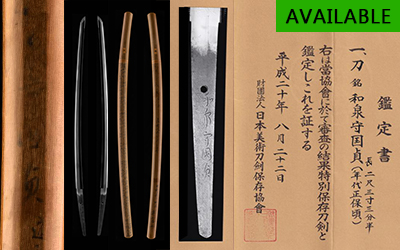
- Kanteisho: Tokubetsu Hozon
- Video: https://www.youtube.com/watch?v=A4oyVs7IkV8&t=227s
Article below by Darcy Brockbank.
The Yamashiro Rai school was founded in legend by a smith named Kuniyoshi, who is considered to have come from Korea. The character Rai 来 means come,
and the implication is that this relates to the founder coming from overseas to Japan. There are no extant works by Rai Kuniyoshi though, so in practical terms the founder of Rai is considered to be Rai Kuniyuki. His style is purely mid Kamakura, making majestic broad blades with dense choji hamon.
The son of Rai Kuniyuki is the smith referred to as Niji Kunitoshi (i.e. two-character Kunitoshi
). Signed work by this smith is generally in the style of his father, utilizing choji in the hamon and with the wide blade and ikubi kissaki of the times. There is some confusion because following Niji Kunitoshi is the smith referred to as Rai Kunitoshi. The work of Rai Kunitoshi in contrast is more elegant and less flamboyant, often featuring suguba and a tapering sugata. When his signature is found, it takes the form of three characters reading 来國俊 (Rai Kunitoshi). He can alternately be called Sanji Kunitoshi (three character Kunitoshi).
Luckily for us, there is a dated work of 1315 by Rai Kunitoshi where he placed his age of 75 years on the nakago. Homma sensei, the founder of the NBTHK and renowned expert on Nihonto, wrote this about Rai Kunitoshi in Great Masterpieces of Japanese Art Swords:
[In regards to the dated work at 75 years of age] … Together with the date inscription, this is an important reference material for the study of Rai works. Of those signed works by Rai Kunitoshi which have been examined to date, the earliest is dated Sho-o 3-nen (at the age of fifty), and [the latest is] Genkyo Gan-nen (at the age of eighty-one).
Fifty years of age would seem to be unusually late for a smith of grandmaster skill to appear on the scene. There is dated work by Niji Kunitoshi, a famous one with the date of 1278, and one with the date of 1286. There is no other dated work by Niji Kunitoshi that I am aware of, and if we are to believe that these works are by Rai Kunitoshi at the beginning of his career then this would make him 38 and 46 years old at their time of production, which would allow him decades of experience to accumulate the skill he displays under the old signature style.
Fujishiro has weighed in on the one smith / two smith theory as well, writing:
The theory that two kanji Kunitoshi and Rai Kunitoshi were separate persons is a theory that ignores the style changes of the times (See Nagamitsu). In the Showa Gonen Book section of the Kanchiin Hon, beneath a Kunitoshi two kanji signature nakago, it says, “Rai Magotaro Nyudo, kogiri yasuri, becomes wide sugu yakiba”, and this is a record which coincides with the time when Kunitoshi and Kunimitsu nado were living. What became clear in later years was that it was discovered that his works covered a long period of time, due to works inscribed with Showa Yonen Nanajugosai (Showa 4, 75 years of age) and Bunpo Gannen Seinen nanajuhachi (Bunpo 1 age 78). Also, the two character Kunitoshi period coincides with the prime of his life, and backs up the one generation theory.
Furthermore, he indicates that Rai Kunitoshi is one of the smiths who was famous in his own time. He writes:
It is not hard to imagine why the kaji Kunitoshi, Kunimitsu, and father and son Kunitsugu were famous and prospered in their time. Among the names of the swordsmiths that have been handed down to the present day, there are two cases, the one in which their fame was circulated about while they were still living, and those which became famous after they died. It is probably reasonable to consider Kunitoshi nado among the former.
Rai Kunitoshi has long been considered to be one of the top three tanto makers of all time, and stands with Awataguchi Yoshimitsu and Shintogo Kunimitsu in this elite club. The form of his tanto are considered to have achieved perfection and are the archetype used to describle late Kamakura tanto work.
The Students of Rai Kunitoshi
Rai Kunitoshi had many fine students, and as Fujishiro wrote he was famous in his own time in the capital city Kyoto. These students made works called daisaku and daimei which were works made in substitution for the teacher, and works made by the teacher but signed by the student on his behalf. There is some disagreement on what these terms mean, but I will quote Kokan Nagayama who is authoritative:
Daimei: When a swordsmith’s signature is chiseled onto a sword by his son or student with his permission, this signature is called a daimei (“substitute signature”) and regarded as equivalent to the real signature. it seems that students also often produced swords in their teacher’s or father’s style, with full permission. Production of this sword is known as daisaku (“substitute production”), and such blades were often signed by the teacher rather than the student. These signatures are also regarded as authentic.The Connoisseur’s Book of Japanese Swords
So a daimei, substitute signature, is work of the teacher which has been subsequently signed on his behalf by one of his students. Daisaku is work of the student, which bears the teacher’s name, with his permission. In the case of daisaku, the teacher may have signed the blade himself or the student may have put the teacher’s signature on the blade with his teacher’s permission. Sometimes the term daisaku-daimei is used for this type of blade, where everything is done by the student, substituting for the teacher.
Manufacture of a Japanese sword is a team effort in the best of cases. The master smith directs the hammer work of his best students who have not yet graduated into making their own blades independently. Preparation work in the forge, cutting charcoal for instance, is done by students lower on the learning curve. The master swordsmith is equivalent to a general and directs the actions of his team in fabricating a sword. Everything is performed to his specification, under his training. Students are on a path to taking on responsibility for independently fabricating things. One of the stages of this, they are instructed in inscribing signatures, and finally of course they will be given instruction in fabrication and eventually will have their own hammer-men and students which they will direct themselves in making their own swords.
The major workshops such as Osafune Nagamitsu’s in the late Kamakura period had many master smiths working under Nagamitsu’s tutelage. Nagamitsu’s workshop had the following master smiths that we know of: Sanenaga, Kagemitsu, Chikakage, Norimitsu, Kagemasa, Nagamoto, Mitsukane, Moritada, and Morishige. The most skilled of these smiths were Kagemitsu, Sanenaga and Chikakage and Kagemitsu went on to head the workshop with the passing of Nagamitsu. As one can imagine some of these smiths were older and more senior to the others, and over time would graduate and make swords on their own in the workshop, bearing their own signatures. But the presence of all of these master smiths allowed Nagamitsu to be very efficient in the manufacture of blades.
Daisaku and daimei blades are one means of this efficiency. When a senior student is close to working on his own in charge of a group of junior smiths, he may be called upon to make daimei which basically will free up time for the master smith to continue fabricating blades. This also trains the soon-to-graduate pupil in signature craftsmanship and gives the teacher a chance to observe, correct, and guide his signing actions. Daimei are usually works that will be seen in the twilight of the teacher’s life, when he is no longer healthy enough to continue working in the shop but as long as he lives he is considered the leader and head smith. If the students are sufficiently advanced, they will be able to produce swords independently but under his guidance, and the final product inspected and authorized to bear his signature. During this time the students will likely also be independent and able to sign their own names to blades. The best of the students will be granted one character or possibly the full name of the master smith. In this way we see the lineage of smiths passing down a character of their name. For example: MITSUtada to NagaMITSU to KageMITSU to KaneMITSU to MasaMITSU.
The Six Signature Styles of Rai Kunitoshi
Rai Kunitoshi’s shop was also a major center of sword fabrication, and he had many master smiths working under his guidance. These students were Rai Kunimitsu, Rai Kuninaga, Rai Kunitsugu, Rai Kunizane, Rai Kunisue, Rai Mitsukane, Rai Tomokuni, and Ryokai. Interestingly enough, Rai Mitsukane was one of the students of Nagamitsu as well, but moved to Kyoto and joined Rai Kunitoshi’s workshop.
This is of consequence because when we examine all of the signatures of Rai Kunitoshi we see two important things. The first is that Kunitoshi’s signature evolves in obvious and subtle ways. The obvious case is that he adds the character Rai (来) to his signature sometime between the ages of 38 and 48. Secondly we see the construction of the Kuni (国) character evolving over time. Below, I have attempted to sketch out the evolution. The general habit though is that he uses a flat, continuous stroke through the upper middle of the Rai character. The Kuni has four slightly up-tilted horizontal strokes.
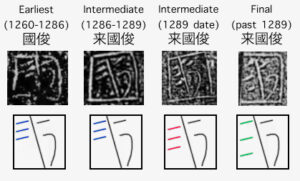
- The leftmost early work is from the two character “Niji Kunitoshi” signature style that lacks the Rai character. For this reason we know it is earliest.
- The second panel is from a tachi with a Rai Kunitoshi 3 character “Sanji” signature. This Kuni character completely matches the old style of the Niji Kunitoshi signatures. Because of this it must be an early transitional signature, where he followed the pattern of his old signature but has just added the Rai above it. As such I place this between the 1286 last dated work of Niji Kunitoshi and before the 1289 dated Rai Kunitoshi work in the third panel, which is showing some drift in the horizontal strokes in the kuni, shown in red.
- The third panel is from a tanto with a 1289 date. This is the earliest dated work of Rai Kunitoshi. Since we know he is 75 years old in 1315, this work was made when he was 49 years old.
- Later work appears to continue this drift as the horizontal strokes spread (shown in green) to cover the available space in the Kuni character, so I place this as the last and final form of the style of his writing.
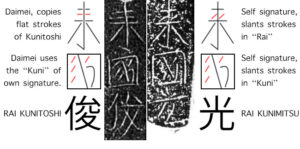
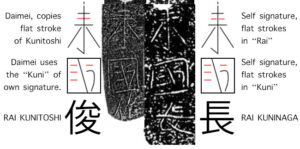
Besides these three major forms of signature in Rai Kunitoshi works, we see three other distinct styles. In each of these, the Rai character emulates the strokes of the master signature group, but the Kuni character is very different. In each of these three cases there is a direct correspondence in the Kuni character to the signatures of Rai Kunimitsu, Rai Kuninaga, and Rai Kunitsugu. The theory then is that these three other signature patterns represent daimei blades, with the individual differences in the Kuni character reflecting the student tasked with placing the signature into the blade (as kind of a code, or signature-within-a-signature). Each of these students seems to have taken pains to make his own signature distinct from the other students by making specific stroke angles on the various short strokes in the characters of his name. This follows through to their construction of the Rai character when signing for themselves, but not when signing for the master.
The following contains my research as not much information is given in major texts about daimei blades. Fujishiro makes some attempt to classify the daimei of Kunitsugu and Kunimitsu in the following statement:
The `Rai’ and `Kuni’ of Kunitoshi, Kunimitsu and Kunitsugu are recognizably different, as in the plate to the left. The `Kuni’ kanji of Kunimitsu and Kunitsugu are almost the same, but as for Kunitoshi, in those with the Shōwa nengo, there are the kanji in which it is in between the `Kuni’ of Kunimitsu and Kunitsugu. As for his final year of Gen’ō, it is a `Kuni’ like that of Kunimitsu. Also […] there is one in which the `Kuni’ looks like that of Kunitsugu. I also think it is a daimei of Kunimitsu nado.
I think he is not correct speculating that Kunimitsu made daimei in the style of Kunitsugu’s signature, and he did not see any that were in the style of Rai Kuninaga so missed one category of signature . So I will pick up where Fujishiro leaves off as I think these daimei were made specifically with the signature differences as a code indicating which student made the signature.
Rai Kunimitsu Daimei
Rai has up-tilted strokes through the upper middle instead of straight.
Kuni has four steeply up-tilted horizontal strokes (more so than the master signature group).
Rai Kuninaga Daimei
Rai has two flat strokes through the upper middle.
Kuni has four flat horizontal strokes.
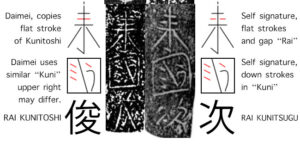
Proposed Rai Kunitsugu Daimei
Rai has two flat strokes through the upper middle.
Kuni has four down-tilted horizontal strokes.
Analysis
When these Rai smiths make daimei, they seem to abandon their own version of the Rai character and use Kunitoshi’s, and then they make sure to use their own Kuni. There is actually a sixth version of Kuni (2 from Kunitoshi himself, 3 from these students, plus the last one). This last version seems to me to be Rai Kunitsugu again as it shares three of the four down-tilted horizontal strokes, and otherwise appears to be his hand at work. The fourth stroke is up-tilted as per the master signature group. It is possible that this is a fourth student making daimei, such as Ryokai or one of the others, but for now I have just grouped this pattern with Rai Kunitsugu.
I have performed this analysis only by looking over clear signatures from oshigata I have access to. I don’t otherwise believe that Rai Kunitoshi would be making six different signatures for himself, and the variations correspond too well with the signatures of the students I think for another suitable explanation, as well as following this simple and clear “coding” pattern which makes it possible to ascertain which student was given the task of finishing the work in each case.