

Project Description
- Status: Available
- Kanteisho: Hozon
- Video: https://www.youtube.com/watch?v=3jzFWv_TcL0
This exceptional daishō (paired long and short swords) brings together a Nanbokuchō-period katana attributed to Chiyozuru (Echizen Rai school) with a companion Muromachi-period wakizashi by Fuyuhiro. Both blades are mounted in high quality Edo-period koshirae that is representative of samurai taste and elegance.
Chiyozuru Katana (Nanbokuchō Period, 14th Century)
The longer sword of the pair is an unsigned (ō-suriage mumei) katana attributed by the NBTHK to the Echizen Rai school founded by Rai Kuniyasu – also known by the name Chiyozuru. Rai Kuniyasu (Chiyozuru) moved from Yamashiro to Echizen in the mid-1300s to establish this branch of the famous Rai lineage. Blades of the Echizen Rai school closely mirror the refined style of their Yamashiro Rai counterparts, and this example reflects that heritage in its elegant form and tempering reminiscent of Rai masters such as Rai Kunitoshi.
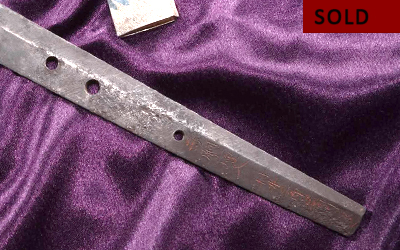
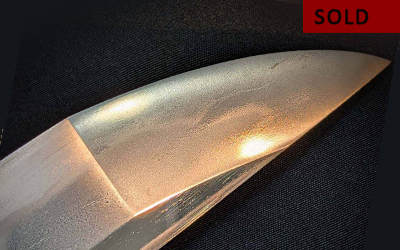
This katana retains an elegant sugata representative of its time. The blade proudly displays a subtle hamon in the classic Rai style: a nie-deki suguha (straight temper line forged in crystalline nie) with abundant ashi (downward wispy lines) lending it a lively undulation. Accompanying the hamon, the jihada (surface grain) is a beautiful mix of itame and masame with fine ji-nie sprinkled throughout. Careful examination reveals dark chikei streaks and even a faint nie-utsuri in the ji, testament to the sword’s quality and old Rai roots.
Fuyuhiro Wakizashi (Muromachi Period, 15th–16th Century)
Paired with the katana is a wakizashi attributed to a smith of the Fuyuhiro lineage. The Fuyuhiro line spans some 17 generations from the late Muromachi into the Edo era. Its founder (circa 1460) trained in the renowned Sōshū tradition (Sagami province) before establishing himself in Wakasa province. Fuyuhiro swords were held in high esteem and eagerly sought by daimyō and samurai during the Sengoku (Warring States) period. This lineage’s work, as seen in our wakizashi, embodies a synthesis of Sōshū-inspired vigor and regional craftsmanship.
This blade features a hamon that is more exuberant – a gunome-midare pattern of undulating peaks, blending sections of straight tempered line with gentle rhythmic gunome waves. The hamon is rich with hataraki (activities): look for bright nie crystals along the edge and sweeping sunagashi lines that testify to the smith’s skill. Tiny ko-ashi foot-like marks dance toward the cutting edge, adding further texture to the temper. The jigane of this wakizashi is a well forged itame, with dense ji-nie. These traits are hallmarks of the Fuyuhiro school’s workmanship – combining robustness with details inherited from their Sōshū lineage.
Edo-Period Koshirae (mountings) and kanteisho (certification)
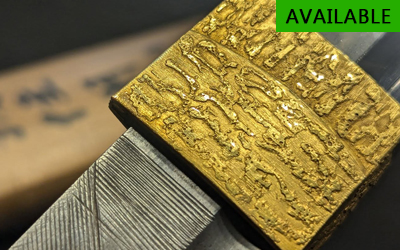
The blades are in historically original matching koshirae. The fuchigashira is a signed Omori set in deep blade shakudo in the theme of waves with water droplets in gold. The tsuba is likewise in deep blade shakudo of high quality, in sukashi with gold mimi (rim). The set are an original pairing and signed Goto Seijo.
This daishō is accompanied by matching NBTHK papers for both the katana and wakizashi, providing official authentication and appraisal from the Nihon Bijutsu Tōken Hozon Kyōkai (Society for the Preservation of the Japanese Art Sword). Each blade has its own recent kanteisho certificate attesting to its Hozon Tōken status (worthy of preservation) and identifying it as follows:
Katana: Mumei – Chiyozuru. The NBTHK examiners have attributed the unsigned katana to the Chiyozuru school (Echizen Rai), Nanbokuchō period. This paper confirms the lineage and era of the blade, which aligns perfectly with the historical analysis provided above. The Hozon paper (issued Reiwa 6, or 2024) documents the blade’s Nagasa (length ~70cm) and other key specs, and certifies it as an authentic antique Japanese sword of historical and artistic merit.
Wakizashi: Mumei – Fuyuhiro. The wakizashi’s NBTHK Hozon paper attributes it to Fuyuhiro, specifying likely late Muromachi period origins. It similarly notes the blade’s dimensions (~36 cm nagasa) and characteristics, and vouches for its authenticity and well-preserved state.
Each blade has been registered as dated Showa 27, corresponding to the one of the earliest postwar registrations of these swords in 1952. The papers being “matching” in this context means the pair went through both registration and shinsa together, reinforcing the notion that they have been kept as a true daishō. It’s quite rare to find a historically assembled daishō where both swords remained intact together. The NBTHK Hozon kanteisho, confirms the authenticity of this daishō set of blades as worthy of preservation and study.