

Project Info
Project Description
- Status: Reference
- Kanteisho: Juyo Token
Designation: Juyo Tōken, 55th Shinsa
Date of Designation: Heisei 21 (2009), October 16
Owner: Fujita Kazuo (Tokyo)
Blade
Mei: Mumei
Era: Sue-Sa (Late Muromachi period)
Measurements
Nagasa: 70.7 cm
Sori: 1.4 cm
Motohaba: 2.95 cm
Sakihaba: 2.05 cm
Kissaki: 3.3 cm
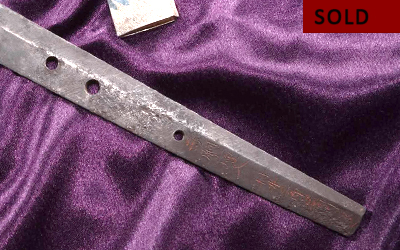
Nakago: suriage
Mekugi-ana: 1
Kitae (Forging):
Itame hada with mokume mixed in, appearing as flowing and layering texture. The jigane is well-refined and there is prominent ji-nie, with notable chikei.
Hamon:
A suguha-based midare with a shallow notare undulation and consistent appearance, featuring thick nie, with active sunagashi and kinsuji working throughout. The ha is bright and vivid with abundant activity.
Bōshi:
A pointed ko-maru return with frequent hakikake and a deep turn-back.
Horimono:
The omote features a gomabashi and the ura a bōhi with kaki-nagashi style termination.
Nakago:
Suriage. Kirijiri. One mekugi-ana.
Setsumei (Explanation):
In the early Nanbokuchō period, the Sa school emerged in Chikugo Province with the founder Sa Sadayoshi, who created a unique style and passed it down to his students. This lineage prospered and produced works that differ from other Kyushu traditions. Their smiths commonly included the character 左 (Sa) in their mei, such as Yasuyoshi, Yukihiro, Yukihisa, and others.
These smiths created flamboyant hamon in a midare pattern with prominent nie, giving the blades a bright and active appearance.
This blade is an unsigned example attributed to the Sue-Sa school. It features a broad mihaba and an extended kissaki, with shallow curvature, reflecting a late Muromachi period sugata. The kitae is itame mixed with mokume and displays refined steel with strong ji-nie. The hamon is a shallow notare-midare with thick nie and rich hataraki including sunagashi and kinsuji. The bōshi has a pointed return and prominent hakikake.
This blade exemplifies the traits of the Sue-Sa school and is highly regarded as a fine example from this tradition.
The Sue-Sa school (末左) of swordsmithing refers to the later generation of the Chikuzen “Sa” lineage founded by Ō-Sa (Samonji) during the Nanbokuchō period (14th century). Ō-Sa – known as Chikuzen Samonji and honored with the nickname “Great Sa” – was a renowned student of the master Masamune in Sagami. He established his forge in Chikuzen Province (northern Kyūshū) around the Ryakuō era (c. 1338–1340), making him one of Masamune’s last disciples. Unlike earlier Kyūshū smiths, whose work was often simple and suguha-based, Ō-Sa embraced the advanced Sōshū-den techniques learned from Masamune, casting off the rustic local style to create a more refined and innovative Soshu-inspired workmanship. The term “Sue-Sa” (literally “late Sa”) thus denotes the later students of Ō-Sa, all of whom were active in the mid-14th century Nanbokuchō era – a point of distinction, as this school predates the Muromachi-period “Sue” sword traditions of the 15th–16th centuries. In other words, the Sue-Sa smiths were the direct followers and heirs of Ō-Sa’s school, working in the Masamune lineage during the Nanbokuchō period, rather than products of the later Muromachi-era sword boom.
Several distinguished swordsmiths are counted among the Sue-Sa school, all essentially the “next generation” after Ō-Sa. These include Sa Yasuyoshi, Sa Yukihiro, Sa Kunihiro, Sa Yoshisada, Sa Hiroyuki, Sa Hiroyasu, and Sa Sadayoshi, among others. Most were either direct apprentices or descendants of Ō-Sa. For example, Yasuyoshi (often thought to have been Ō-Sa’s son) carried the tradition to neighboring provinces and is said to have founded a branch in Nagato. Ō-Sa’s own son, Yukihiro, produced works nearly indistinguishable from his father’s – a National Treasure tantō by Yukihiro dated 1350 mirrors Ō-Sa’s style exactly. All of these Sue-Sa smiths were highly skilled and worked in remarkably similar fashion, faithfully continuing their master’s Sōshū-derived style. In fact, few developed unique personal quirks, which means that unsigned blades from this school can rarely be attributed to a specific individual with certainty – experts often must attribute such a blade simply to “Sue-Sa” in general. This close adherence to Ō-Sa’s style underscored their mission: to preserve and propagate Masamune’s forging principles in Kyūshū. The Sue-Sa smiths thus upheld a high standard of craftsmanship, and their works were esteemed in their time for superb sharpness and sophisticated beauty, remaining important as a regional continuation of the Masamune lineage.
A Sue-Sa katana attributed to the school (Nanbokuchō period, 14th century), showing the broad blade and long kissaki characteristic of this lineage. Such swords were often originally large ōdachi or naginata-naoshi with “heroic” Nanbokuchō sugata, later shortened for practicality.
Sue-Sa blades are celebrated for combining the grand dimensions of mid-14th century swords with the exquisite details of the Sōshū style. In terms of sugata (overall shape), they often exhibit an imposing Nanbokuchō silhouette – blades are typically broad with only slight taper, a thick kasane (spine), and an extended ō-kissaki. This gives a magnificent, powerful form well suited to the martial needs of the era. The hada is usually a finely forged itame-hada mixed with mokume, sometimes showing areas of flowing grain; the entire surface is packed with ji-nie and chikei , which can impart a moist, slightly whitish hue to the steel. This rich jihada reflects the skilled folding techniques and high-quality tamahagane iron used by the Sa smiths.
The hamon (hardened temper line) on Sue-Sa works follows the Sōshū-den tradition and is invariably nie-rich and activity-filled. Many blades feature a vigorous notare-midare hamon with deep nioi foundation and profuse nie, mixed with small gunome peaks and even spots of tobiyaki – a complex pattern glowing with vibrant hataraki like sunagashi and bright kinsuji that testify to the Soshu influence. Even those pieces made in a quieter suguha style display an abundance of nie and subtle activities along the habuchi, clearly distinguishing them from the plain, sedate suguha of traditional old Kyūshū blades. The bōshi is a signature trait of this school – commonly called the “Sa-bōshi” – which is nearly pointed in a thrusting manner with a long kaeri running down the mune. This yields a bold, extended tip that often appears as a flaring flame shape. The nioiguchi of the turn-back is bright and clear, and in some examples the bōshi is extraordinarily long, with prominent kinsuji streaks lighting up the point. These combined features – the broad Nanbokuchō shape, the beautiful ji-hada laden with ji-nie, the energetically patterned nie hamon, and the distinctive Sa-bōshi – make Sue-Sa swords immediately recognizable to knowledgeable collectors. Each blade embodies a dynamic yet refined style, marrying Masamune’s Sōshū aesthetic with Kyūshū craftsmanship.