

Project Description
Yamashiro-den Tachi by Rai Kunizane (Shōwa 1312–1317) – NBTHK Tokubetsu Hozon
- Status: Sold
- Kanteisho: Tokubetsu Hozon
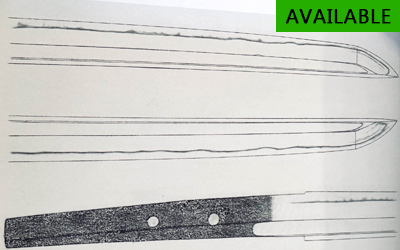
This is an exceptional Yamashiro-den tachi is by Rai Kunizane, dating to the Shōwa era (1312–1317) in the late Kamakura period. The blade is accompanied by NBTHK Tokubetsu Hozon papers attesting to its quality and authenticity. It measures approximately 2 shaku 3 sun 1 bu in cutting length (~70.0 cm nagasa), and is housed in a high-quality shirasaya with a solid silver habaki. The sword is in fresh Japanese polish and remains in superb health.
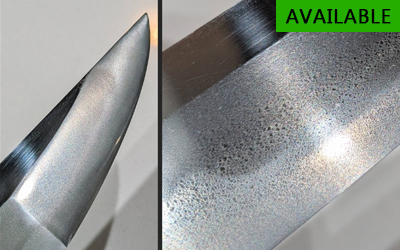
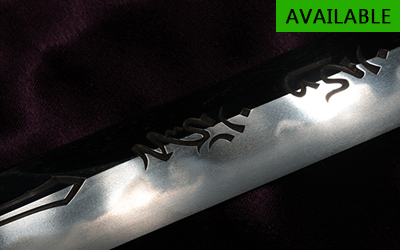
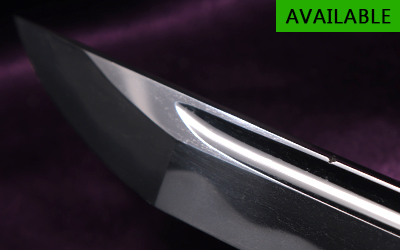
This tachi exhibits textbook Yamashiro Rai traits. The jihada is a very fine ko-itame jihada, tightly forged with abundant ji-nie across the surface. This rich deposit of ji-nie produces beautiful chikei and even a faint misty nie utsuri, a hallmark of superior Rai blades. The hamon is a refined suguha-chō midare, executed in a bright ko-nie deki. Small ko-chōji clove patterns and subtle ko-gunome undulations mix into the straight hamon, which is enlivened by deep ashi and fine internal activities. One can observe several fine kinsuji and yō within the hamon. The bōshi is finished in a slight ko-maru with a turn-back, in the classic Rai style. Overall, the blade’s shape is graceful and well-proportioned – a gently curving tachi with a deep torizori.
This harmonious workmanship bears a strong resemblance to the blades of Rai Kunitoshi. The tight ko-itame jigane with profuse ji-nie and the restrained, straight hamon with small midare elements are hallmarks of Rai Kunitoshi’s style, here faithfully reflected in Kunizane’s work.
Historical Background: The Rai School and Kunizane
The Rai school, founded by Rai Kuniyuki in the mid-13th century, was one of the principal swordmaking traditions of Kyoto (Yamashiro province) – alongside the famed Awataguchi school – and remained active from the late Kamakura through the Nanbokuchō period. Rai blades were esteemed for their superb craftsmanship and elegant beauty, embodying the refined taste of the imperial capital. Rai Kunitoshi (来国俊), son of Kuniyuki, emerged as the school’s greatest master and is considered one of the premier swordsmiths of all time. Working in Kyoto in the late 1200s to early 1300s, Kunitoshi produced many extant masterpieces and attracted a prestigious clientele. He was famed for his exquisite Yamashiro jitetsu, featuring fine ko-itame grain with ji-nie, and for his elegant suguha-based hamon with active hataraki. The Rai style, together with the earlier Awataguchi style, thus defines the classical Kyoto tradition: a focus on flawless jigane, a relatively restrained yet beautiful hamon, and overall an air of elegant harmony.
Rai Kunitoshi’s legacy was carried on by a distinguished lineage of sons and students. His immediate successor was Rai Kunimitsu (来国光), widely believed to be Kunitoshi’s son. Kunimitsu took over the Rai forge in the early 14th century and continued the school’s high standards into the Nanbokuchō era. Many of Kunimitsu’s works show the beginning of Nanbokuchō stylistic trends – they are often broader and grander in sugata (with a slightly larger kissaki and less taper), presaging the era’s preference for larger swords. Yet even in these more robust proportions, Kunimitsu maintained the quintessential Rai characteristics: a fine tight hada with plentiful ji-nie and a suguha-based hamon mixed with small choji, gunome, ample ashi and yō, much like his father’s style. His signed blades (some dated to the 1320s–1340s) demonstrate a seamless continuation of Rai Kunitoshi’s artistry, such that Kunimitsu is ranked on par with his father in quality and importance.
Another prominent figure of the Rai lineage was Rai Kuninaga (来国長), one of Kunitoshi’s top disciples. Around 1329, Kuninaga moved from Kyoto to Nakajima in Settsu province, establishing the Nakajima-Rai branch of the school. He remained a loyal inheritor of the Rai style – indeed, historical records note that Kunitoshi entrusted Kuninaga (along with a few others) to sign blades on his behalf (dai-saku), reflecting great confidence in his work. Rai Kuninaga’s swords continue the traditional Rai features, with sugaha-based hamon and fine jihada, though some observers note that certain minute activities (such as profuse kinsuji and abundant ashi that typify Rai Kunitoshi’s very best works) are somewhat less pronounced in Kuninaga’s extant blades. Nonetheless, together with Rai Kunimitsu and Rai Kunitsugu, Kuninaga is regarded as one of the three significant smiths who upheld Kunitoshi’s legacy at the highest level. The Rai school’s artistic tendencies – an emphasis on refined simplicity, superior metallurgy, and elegant form – were thus preserved and even spread beyond Kyoto through figures like Kuninaga, influencing other regional traditions (for example, the Enju school in Kyushu was founded by a Rai student).
Within this illustrious lineage, Rai Kunizane (来国真) holds a special place. He is recorded as a son of Rai Kunitoshi and is traditionally noted as the younger brother of Rai Kunimitsu. Kunizane was working in Yamashiro during the tumultuous late Kamakura to Nanbokuchō period – the era of the Northern and Southern Courts – which corresponds roughly to the Shōwa era (1312–1317) into the 1330s. Historical sources indicate that there were actually two generations of smiths using the name Kunizane (very likely father and son), spanning into the mid-Nanbokucho period. In practice, however, works by Rai Kunizane are quite scarce. He did not establish a long independent line, and it is believed that Kunizane spent much of his career working within his father’s workshop and under the Rai school’s main line (assisting Kunitoshi and Kunimitsu). As a result, relatively few blades signed with “Kunizane” have survived or been identified – and those that do surface often display such a high level of craftsmanship that one can understand why Kunizane’s style was virtually indistinguishable from his father’s. In fact, Kunizane’s work “looks like his father’s”, so much so that it strongly recalls Rai Kunitoshi’s own masterpieces.
This offered tachi is therefore a particularly important and rare example of Kunizane’s oeuvre. It encapsulates the Rai school’s genius as passed down from Kunitoshi, through Kunimitsu and the extended Rai lineage, into Kunizane’s hands. The blade’s fine Rai jigane and elegant suguha-based hamon could easily be mistaken for the work of Rai Kunitoshi or Kunimitsu at first glance – a testament to the continuity of style and skill in this family. For the collector, this piece delivers all the hallmark beauty of a high-grade Rai sword, combined with the added intrigue of Kunizane’s relative obscurity. It is accompanied by NBTHK Tokubetsu Hozon papers, affirming both the authenticity of the signature and the outstanding quality of the sword. In short, this is a refined Kamakura-period tachi that bridges generations of the Rai school: a sword of graceful form, brilliant craftsmanship, and rich historical significance within the Kyoto tradition.