

Project Info
Project Description
Kawabe Suishinshi Fujiwara Masatsugu
- Status: Sold
- Kanteisho: NTHK
Kawabe Suishinshi Fujiwara Masatsugu – (kao)
Koka ni nen hachi hatsu hi
Horimono Honjo (no) Suke Yoshitane
This exceptional katana is the work of Suishinshi Masatsugu, one of the most accomplished disciples of Taikei Naotane, and grandson in spirit of the legendary Suishinshi Masahide, founder of the Shintō revival movement. Dated to Kōka 2 (1845), this blade embodies the refined ideals of the fukko-tō philosophy—the “return to the classical”—with workmanship modeled on the masterpieces of the Kamakura and Nambokuchō periods.
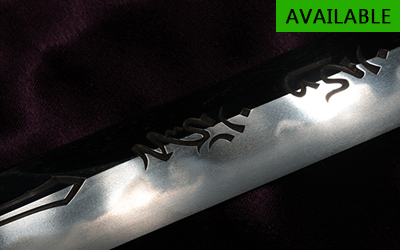
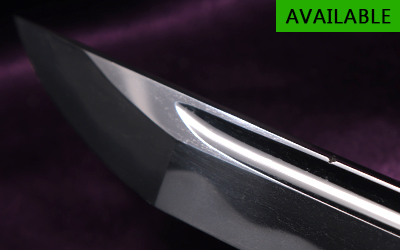
The blade bears a horimono carved by Honjo Yoshitane, one of the most renowned chōkoku-shi (engravers) in Japanese sword history, whose work adorned blades by Naotane, Masahide, and their finest students. The Marishiten goddess on the omote and ken horimono on the ura are executed in precise relief, embodying both spiritual protection and aesthetic harmony.
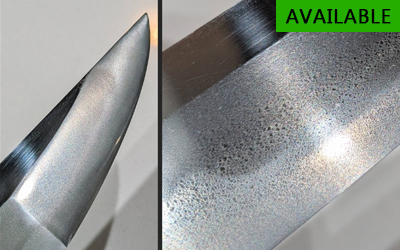
The jihada is a beautiful mokume mixed with itame, flowing elegantly into masame above the shinogi, a trait characteristic of Masatsugu’s hand. The steel presents a subdued bluish-gray tone covered in dense ji-nie and fine chikei, with a smooth and moist texture that captures the sophistication of the Yamashiro-den influence Masahide sought to revive.
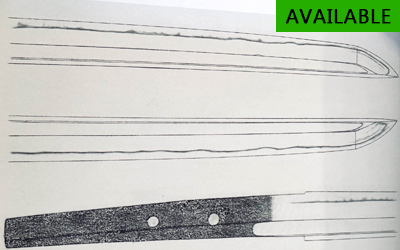
The hamon is a vibrant gonome-chōji-midare in a bright ko-nie-deki, with intricate kinsuji, inazuma, and fine nioi-ashi cascading toward the ha. The bōshi is yakizume, turning back with soft hakikake, and the nakago remains ubu with Masatsugu’s full signature on the omote and the horimono inscription by Yoshitane on the ura.
This sword exhibits perfect balance, vitality in the hamon, and a steel texture that conveys both power and serenity—hallmarks of the Suishinshi tradition.
Lineage and the Suishinshi School
The Suishinshi lineage represents the rebirth of classical Japanese swordmaking in the late Edo period. Founded by Suishinshi Masahide (1750–1825), the school championed the ideals of the fukko-tō movement, urging a return to the forging methods of the Kamakura masters. Masahide’s influence spread across Japan, reshaping the techniques of the Shintō and Shinshintō periods.
His son, Suishinshi Sadahide (Masahide II), continued the tradition, producing works of profound clarity and refinement before his untimely death in 1825. Leadership then passed to Taikei Naotane, Masahide’s foremost disciple, whose genius carried the school to its zenith.
Among Naotane’s students, Suishinshi Masatsugu (Kawabe Fujiwara Masatsugu) stood out for his purity of style and his deep loyalty to the ideals of his forebears. Adopted and trained by Naotane after Sadahide’s death, Masatsugu became not only his pupil but his son-in-law, inheriting both the artistic and spiritual mantle of the Suishinshi school.
Masatsugu’s blades are characterized by controlled elegance, technical perfection, and restrained activity in the hamon—qualities reflecting the discipline and aesthetic vision that defined the late Edo revivalists.
Honjo Yoshitane was among the greatest horimono artists of the 19th century, rivaled only by Umetada Myōjū in the depth and artistry of his carving. Born in Dewa province, Yoshitane first studied under Naotane, later becoming the preferred engraver for Masahide, Masatsugu, Nobuhide, and others within the Suishinshi lineage.
His horimono work displays exquisite control, with three-dimensional depth, rhythmic composition, and lifelike movement. The Marishiten motif on this blade represents the Bujin goddess of the samurai, symbolizing invisibility and fearlessness in battle—a spiritual emblem deeply revered by the warrior class since the Nara period.
Specifications
Type: Katana (tachi mei orientation)
Era: Kōka 2 (1845)
Nagasa: 2 shaku 1 sun 7.5 bu (65.8 cm)
Sori: 1.2 cm
Motohaba: 3.3 cm
Kissaki: Ikubi
Mune: Iori
Hamon: Gonome-chōji-midare with ko-nie, kinsuji, inazuma, ashi, and yo
Jihada: Mokume mixed with itame, masame above shinogi, fine ji-nie and chikei
Bōshi: Yakizume, soft hakikake
Nakago: Ubu, one mekugi-ana
Horimono: Omote – Marishiten; Ura – Sankozuka-ken by Honjo Yoshitane
Habaki: One-piece gold
Mounting: Shirasaya
In excellent quality, the blade is accompanied by NTHK kanteisho.