

Project Description
Kamakura junin Shintogo Kunimitsu tanto
- Status: Reference
- Kanteisho: Tokubetsu Hozon
Shintōgo Kunimitsu is credited as being the founder of the Soshu tradition and with being the teacher of Masamune, Norishige, Yukimitsu and others. Look forward to sharing photos of this tanto when it returns in a couple of weeks. Great appreciation to Markus Sesko for the translation below.
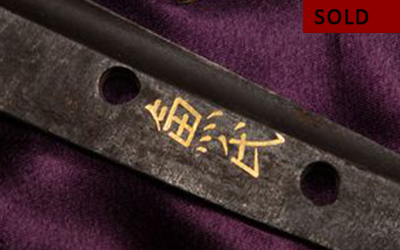
Obverse:
相模國新藤五国光
刃⻑九⼨壱分弱
于時令和紀⾟丑梅⾒⽉
探⼭識焉「花押」
Sagami no Kuni Shintōgo Kunimitsu
Hachō kyū-sun ichi-bu jaku
Toki ni Reiwa-ki kanoto-ushi umemizuki
Tanzan kore o shirusu + kaō
Shintōgo Kunimitsu from Sagami Province
Blade length ~ 27.5 cm
Written by Tanzan [Tanobe Michihiro] in February of the year of the ox of the Reiwa era (2021)
+ monogram.
Reverse:
⼆字有銘同⼯ノ銘ハ左字北冠ノ字形ガ特徴ナレド本作ノ如ク左字デ北冠トナラヌ者亦北冠デ左
字ニナラヌ者モ存在シ是等ノ多クハ細直刃ヲ焼キタルガ通例也本短⼑モ細直刃ヲ焼キ⾝幅ニ⽐
シテ⼨延ヒノ形態ヲ呈シ地沸ヲ厚ク敷ク板⽬ノ肌合ニ地景ヲ著シク織成シ同⼯ノ⼀作域ヲ⽰ス
優品也
Niji yūmei. Dōkō no mei wa hidari-ji kita-kanmuri no jikei ga tokuchō naredo honsaku no gotoku hidari-ji
de kita-kanmuri to naranu mono mata kita-kanmuri de hidari-ji ni naranu mono mo sonzai-shi korera no
ōku wa hoso-suguha o yakitaru tsūrei nari. Hon-tantō mo hoso-suguha o yaki mihaba ni ji-shite sunnobi
no keitai o tei-shi ji-nie o atsuku shiku itame no hada’ai ni chikei o arawashiku orinashi dōkō no issaku’iki
o shimesu yūhin nari.”
Signed with two characters. The characteristic interpretation of Shintōgo Kunimitsu’s signature
is referred to as hidari-ji kita-kanmuri, which is a mnemonic that points out that the smith signed
the left inner part (hidari-ji) of the character for Kuni the opposite way as most other smiths, and
that he executed the upper part (kanmuri) of the character for mitsu in a way that resembles the
cursive variant of the character for “north” (kita). There exist works like this tantō, however, where
the feature of hidari-ji is present in the signature, but not the feature kita-kanmuri, and vice versa.
Regardless of that, most of Kunimitsu’s blades are hardened in a hoso-suguha, which is the case
here as well. The shape of the tantō tends in relation to its mihaba to sunnobi and the blade shows
an itame-hada with plenty of ji-nie and chikei that are interwoven with the forging structure. Thus,
we have here a masterwork that represents one of the smith’s known styles.