

Project Description
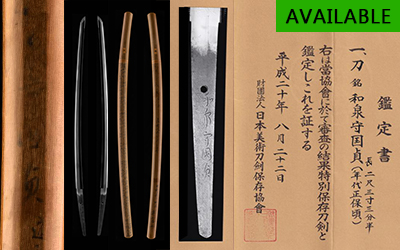
Bitchū Aoe katana
- Status: Hold
- Kanteisho: Tokubetsu Hozon
NBTHK Tokubetsu Hozon Tōken (issued Reiwa 6 / 12.04.2024)
Nagasa: 2 shaku 0 sun 8 bu (approx. 63.0 cm)
Attribution on papers: “Mumei (Aoe)”
This is a mumei katana attributed to Bitchū Aoe, with NBTHK Tokubetsu Hozon certification.
The Aoe tradition belongs to one of the most consequential swordmaking regions in Japan: the compact corridor spanning Bizen and Bitchū, fed by the Yoshii, Asahi, and Takahashi river systems. These waterways carried and deposited high-grade iron sand from the interior mountains, supporting a dense network of elite medieval forges. Within a short distance—on the order of a day’s travel—one encounters the historic centers of Ko-Osafune, Ichimonji lineages, and Aoe, along with related groups distributed along those river valleys. The proximity created a shared technical vocabulary, but the differences in locality and workshop culture produced distinct dialects of workmanship that are recognizable in kantei.
Aoe is particularly interesting because it does not sit neatly inside a single stylistic box. While it is often grouped under the broad umbrella of “Bizen tradition” in the conventional five-tradition framework, many scholars treat Aoe as standing at a peer level in its best periods—an independent regional tradition with a refined character of its own. In practical terms for collectors, Aoe can feel like a bridge between two worlds: the lively midare developments associated with Bizen, and the disciplined elegance of suguba and fine jihada often associated with Yamashiro taste.
That bridging quality is one of Aoe’s signatures: a blade that reads as classical, poised, and confident—never coarse—yet with a regional personality that is unmistakably its own when the details are examined closely.
The Aoe name is traditionally tied to an area associated with Fukuyama village in Bizen, with the working group later established in Bitchū while preserving the Aoe place-name. Aoe’s standing in the broader Kamakura “golden age” narrative is reinforced by its association with the cultural orbit of Emperor Go-Toba, who famously gathered leading smiths from major regions. Aoe smiths are included among the elite group traditionally cited in that circle—an indicator that Aoe workmanship was regarded not as provincial, but as court-level craft in the period’s most competitive artistic environment.
Collectors will encounter multiple naming conventions in the literature. Some authors divide the school into Ko-Aoe → Chū-Aoe → Sue-Aoe, while others use only Ko-Aoe for earlier work and Aoe more broadly thereafter. The NBTHK’s usage is especially practical:
-
“Ko-Aoe” tends to be reserved for clearly earlier Kamakura-period work,
-
while “Aoe” is commonly used as a broader umbrella for later Kamakura into Nanbokuchō and, depending on interpretation, into Muromachi-era survivals.
This matters because many blades that began life as tachi in the medieval period were later shortened for katana wear, and in that process signatures were frequently lost—so school attributions become the principal “name” by which the blade is understood.
Aoe is admired for a set of features that are subtle, technical, and rewarding in hand. Not every example shows each hallmark strongly, but they form the school’s core identity:
-
Jihada character: Aoe is known for refined forging with textures sometimes described as crepe-like chirimen-hada, created by the interplay of fine itame within mokume tendencies, often accompanied by a bright sprinkling of ji-nie that gives the steel a lively surface.
-
Sumi-hada: Areas of steel that appear darker yet clear, a tonal shift within the ji that is frequently cited as a key Aoe tell.
-
Utsuri: Aoe has a special reputation for complex utsuri effects. In strong examples, the ji can show layered, shifting “reflections” and bands that create depth as the blade is rotated in light—one of the most poetic and technically intriguing phenomena in koto sword appreciation.
-
Temper and taste: Aoe is often associated with disciplined suguba sensibilities (and the technical difficulty of making “perfect simplicity”), while also preserving Bizen-adjacent expression such as slanting choji tendencies (saka-chōji) in certain lines and periods.
-
Classical aesthetic and conservatism: During periods when neighboring Bizen schools moved toward different emphases, Aoe is often described as maintaining a more traditional, controlled approach—one reason its best work can feel unusually classical.