Project Description
- Status: Reference
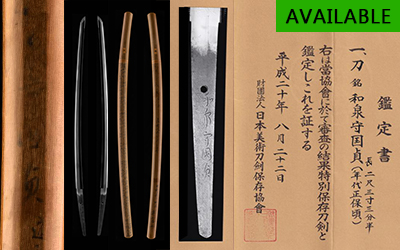
- Kanteisho: Tokubetsu Hozon
Tanobe-sensei sayagaki
Shintōgo from Sagami Province
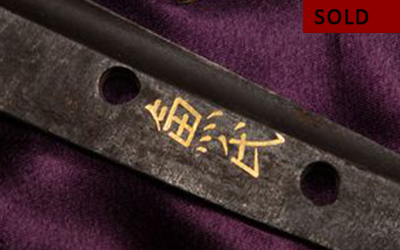
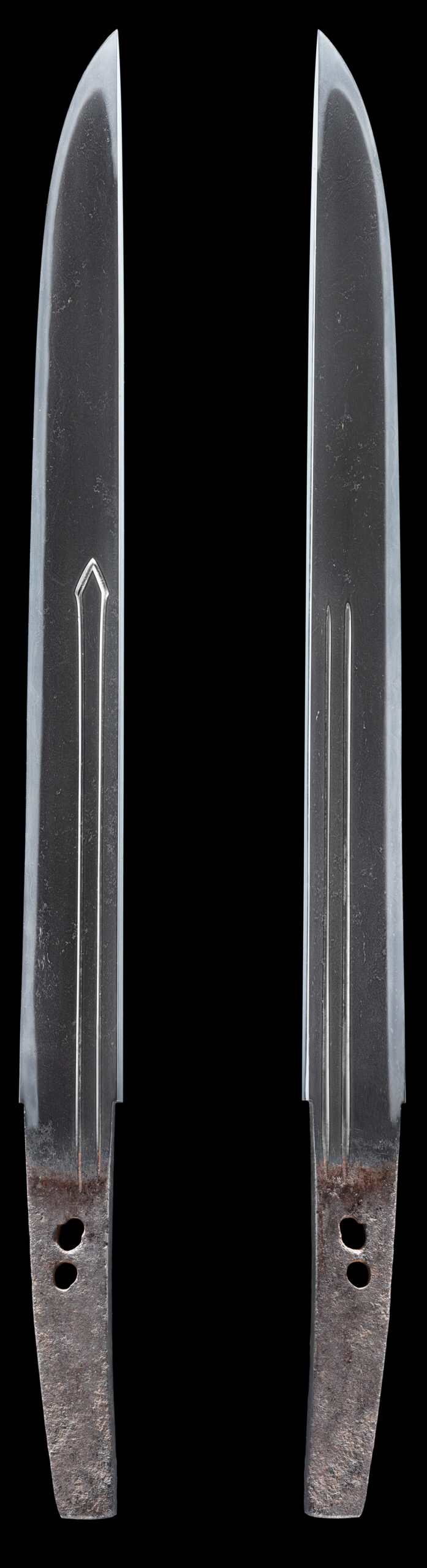
This blade has an ubu-nakago and is mumei.
With a standard uchizori, this blade is of a classically elegant shape. It displays a forging structure in itame that features ji-nie and chikei, an elegant and nie-laden chū-suguha with sparkling nie and with many kinsuji, and a bōshi with a ko-maru-kaeri that runs back in a long fashion. Thus, overall, this masterwork clearly reflects the typical characteristics of [Shintōgo] Kunimitsu.
相州新藤五
キ⾦筋頻リニ働キ⼩丸ニ深ク反ル帽⼦ニ結ブナド国光ノ特⾊ノ顯ラカナ優品也
KUNIMITSU (国光), Shōan (正安, 1299-1302)
Sagami – “Kunimitsu” (国光), “Kamakura-jūnin Shintōgo Kunimitsu” (鎌倉住人新藤五国光), “Kunimitsu Kamakura-jūnin Shintōgo” (国光鎌倉住人新藤五), “Sagami no Kuni Kamakura-jūnin Shintōgo Kunimitsu hōshi hōmyō Kōshin” (相模国鎌倉住人新藤五国光 法師法苗光心, “the Buddhist monk Shintōgo Kunimitsu from Kamakura of Sagami province with the monk name Kōshin”), “Kamakura-jū Shintōgo Kunimitsu hōmyō Kōshin” (鎌倉住新藤五国光法名光心, “Shintōgo Kunimitsu from Kamakura with the monk name Kōshin”), “Shintōgo Hasebe Kunimitsu” (新藤五長谷部国光), “Shintōgo Kunimitsu” (新藤五国光), “Sagami no Kuni Kamakura-jū Hasebe Kunimitsu” (相模国鎌倉住長谷部国光), first name Shintōgo (新藤五), some sources list him also with the name Shintōtarō (新藤太郎), according to tradition the son or student of Awataguchi Kunimitsu (粟田口国光), some say he was the son of Awataguchi Kunitsuna (国綱), because of his family name Hasebe, some assume that he had a certain relationship to the Hasebe school, we know date signatures from the second year of Einin (永仁, 1294) to the fourth year of Genkō (元享, 1324) what means an active period of about 30 years, because of this there exists also a two-generations theory, relative many blades are extant by Kunimitsu and it is said that Hasebe Kunishige (国重) and his son Kunihiro (国広) made daisaku works at the end of Kunimitsu´s career, this is further supported by the fact that his signatures show some differences, in old sword documents we find the entry that Kunimitsu had three sons who all signed with Kunimitsu too, however, he focused on the production of tantō and is considered as one of the best tantō smiths of all times, most of them are somewhat smaller dimensioned and measure about 24 cm, they have no sori or a little uchizori and scarce fukura, that means they show the typical tantō shape of the late Kamakura period, the jigane is a dense ko-mokume with ji-nie all over, also ō-hada or chikei can appear, the hamon is mostly a chū-suguha or a hoso-suguha, in rare very cases also a midareba, a characteristic feature of Kunimitsu is a yakikomi protrusion at the area of the habaki, the nie of the bōshi are rougher than at the rest of the blade and run in a frayed manner into the ji of the bōshi, therefore also the term okina no hige (翁の髭, lit. “beard of an old man”) was used to refer to Kunimitsu’s bōshi, the bōshi itself is a ko-maru with nie-kuzure or appears as yakitsume, the workmanship follows in general the Awataguchi style but gives due of the emphasized nie also an outlook to the upcoming Sōshū tradition, he signed with a niji-mei that has some characteristic features which are summarized to the mnemonic phrase hidari-ji kita-kanmuri (左字北冠) since olden times; the first part of this phrase refers to the fact that he signed the left part of the inner part of the character (ji) for “Kuni” in the opposite way (hidari) as most swordsmiths, i.e. in a way that reminds of the Z or a mirrored S, and further he signed the upper part (kanmuri) of the character for “mitsu” in an abbreviated manner that reminds of th cursive-script variant of the character kita (北) (see picture right), saijō-saku ⦿