

Project Description
- Status: Available
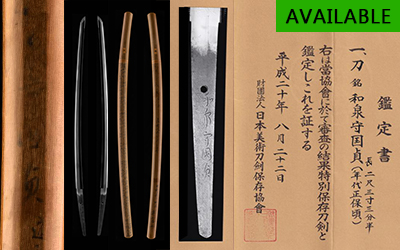
- Kanteisho: Tokubetsu Hozon
Tanobe-sensei sayagaki.
肥後延壽國綱ハ南北朝期ヨリ室町期ニカケテ重代アリテ本太刀ハ南北朝末期ノ作ト鑑セラル
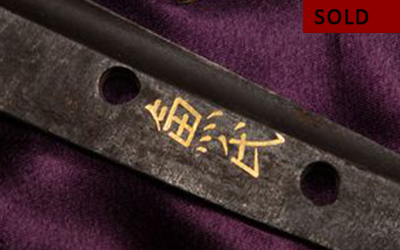
生茲五字銘有之而健全且ツ出來宜色也
Higo Enju Kunitsuna wa Nanbokuchō-ki yori Muromachi-ki ni kakete judai arite, hon tachi wa Nanbokuchō Nambokuchō makki no saku to kantei seraru.
Shōshi goji mei kore ari, shikamo kenzen naru ue ni, deki yoroshiki iro nari.
Higo Enju Kunitsuna had successive generations from the Nanbokuchō period through the Muromachi period, and this tachi is judged to be a work from the late Nambokuchō period. There is a five-character mei from the time of its forging, and not only is it well-preserved, but the workmanship and color are excellent.
Bio, courtesy of Markus Sesko
KUNITSUNA (国綱), Shōhei (正平, 1346-1370), Higo – “Hishū Kikuchi-jū Saemon no Jō Kunitsuna” (肥州菊池住左衛門尉国綱), “Hishū Kikuchi-jū Kunitsuna” (肥州菊池住国綱), “Kunitsuna” (国綱), first name Saemon (左衛門), he is listed as son of Enju Kuniyoshi (国吉) or as son of Enju Kunitomo (国友) and as student of Kuniyoshi, dense ko-itame with nagare and a tendencya shirake, suguha, in rare cases also a notare mixed with ko-midare in ko-nie-deki, kinsuji appear along the habuchi, jō-saku
The Higo Enju School and its Lineage
The Enju school (延寿派) of Higo province has its roots directly in the Yamashiro Rai school, one of the prestigious traditions of Kyoto. Historical accounts relate that the founder of Enju was Enju Tarō Kunimura (国村), who was a grandson or son-in-law of the great Rai master Rai Kuniyuki. Kunimura (also known as Hiromura’s son in some sources) studied in Kyoto under Rai Kuniyuki and married his daughter. Around the Gen’ō era (c. 1319) – which overlaps the late Kamakura period – Kunimura was invited by the powerful Kikuchi clan to move to Higo province (Kumamoto). Lord Kikuchi Takefusa (菊池武房) sponsored this move as part of his efforts to bolster the Kikuchi clan’s arsenal with superior swords. Thus, Kunimura relocated to the Kikuchi district of Higo in the early 14th century, marking the beginning of the Enju school in Kyūshū.
The name “Enju” (延寿) itself is taken from Kunimura’s formal name – Enju Tarō – and it became the hallmark of this Kyūshū-based offshoot of the Rai lineage. The Enju smiths flourished from the late Kamakura through the Nanbokuchō and into the early Muromachi period, roughly a century of activity (circa 1320s–1420s) in Higo. Scholars and sword connoisseurs often divide their work into periods: Ko-Enju (late Kamakura era works by Kunimura and immediate disciples), Chū-Enju (Nanbokuchō period generations), and Sue-Enju (Muromachi period, the later generations). Kunitsuna is counted among the Chū-Enju smiths – those active during the Nanbokuchō period (mid-14th century) when the school was at its height.
The Enju school’s close Rai ancestry meant their style was heavily inspired by Rai techniques. Contemporary assessments note that Enju works “lack sharply distinctive individualities and are largely similar to Rai works”, which is a testament to how faithfully they followed the Rai tradition. Both schools produced elegant tachi with classic proportions – generally graceful with high shinogi and funbari (tapering) like Rai, though Enju pieces tend to be a bit stouter in some cases. There are, however, subtle differences that experts use to distinguish Enju from Yamashiro Rai blades:
Jigane: Enju blades have a very fine ko-itame hada similar to Rai, but often with a tendency toward masame (straight grain) appearing in places. The term “Enju-gane” is sometimes used to describe a certain dark, clean iron with patches of masame that Enju works show. The ji of Enju blades commonly exhibit shirake-utsuri – a faint whitish shadow – even more obviously than Rai works. This utsuri, along with the slightly less vivid jigane, can give Enju steel a somewhat “paler” look compared to Rai. (Tanobe’s mention of ji-nie and a hint of utsuri on this Kunitsuna tachi aligns with these observations.)
Hamon: Enju hamon are most often a restrained chu-suguha (medium-width straight temper) similar to Rai’s, occasionally mixed with tiny midare elements. A key difference noted is that the nioiguchi of Enju tends to be tighter and more subdued, lacking the vibrant, thick nioi cloud that Rai hamon sometimes display. Internal activities (hataraki) in the hamon are generally gentle – one might see small ashi, some ko-nie, perhaps nijūba (double hamon lines) or slight tobiyaki, but not the dramatic activity of Soshu or Soden Bizen works. Enju’s preference was for an understated elegance in the temper line, reflective of their Yamashiro roots. On this sword, the described suguha with ko-nie and controlled nioiguchi is quintessential Enju style.
Bōshi: Enju boshi are noted to often have a larger turn-back curvature but very shallow return. In practice, this means the boshi is rounded and does not extend far back on the mune. Tanobe’s commentary that the boshi is ko-maru with a short return perfectly matches the textbook Enju boshi form, and is one of the subtle tells of an Enju blade versus a Rai blade (which might have a marginally deeper kaeri in some cases).
Within the Enju lineage, Kunitsuna (国綱) is not the founder but one of the noted smiths working probably a generation or two after Kunimura. The Enju school produced many skilled smiths, often with names starting in “Kuni-.” Contemporary records and later analyses list Kuniyoshi, Kunitoki, Kuniyasu, Kunifusa, Kunikiyo, Kunishige, Kunisuke, Kunitsuna, and others as prominent members of the school. These smiths were likely interrelated as family or master-student, and maintained the high quality of the school through the turbulent Nanbokuchō era. While individual styles among them did not diverge greatly, some (like Kuniyoshi or Kunitoki) became particularly renowned. Kunitsuna’s works are less commonly encountered than, say, Kuniyoshi’s, but as this sword demonstrates, they adhere closely to the Enju/Rai style and are prized when found in good condition.