

Project Info
Project Description
Juyo Token Sairen katana
- Status: Sold
- Kanteisho: Juyo Token
第三十三回重要刀剣
Jūyō Tōken Setsumei
Designated on March 25, 1987 (Shōwa 62)
33rd Jūyō Tōken
Owner: Tsuruoka Yunen (Tokyo)
—
Sword
Katana
Inscription: “Hon’ami (with kao) and kinpun-mei”
—
Measurements
Length: 71.8 cm
Curvature (sori): 2.0 cm
Motohaba (width at base): 2.7 cm
Sakihaba (width at tip): 1.9 cm
Kissaki length: 3.5 cm
Nakago length: 18.1 cm
Nakago sori: none
—
Description
Shape: Shinogi-zukuri, iorimune, average width, gentle curvature, chūkissaki.
Jigane: Itame mixed with mokume, with chikei appearing, somewhat standing and textured, with ji-nie attaching.
Hamon: Primarily suguha-chō mixed with gunome, with ashi entering. The yakiba below the yokote is broad, with fine ko-nie clinging and streaming activities.
Bōshi: Midare-komi ending in ko-maru.
Horimono: Bōhi carved on both sides.
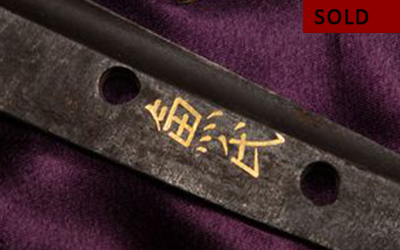
Nakago: Ō-suriage, tip kiri, yasurime katte-sagari, one mekugi-ana. On the omote below the mekugi-ana is inscribed “Sairen (西蓮),” and on the ura in gold powder kinpun-mei is written “Hon’ami (with kao).”
—
Commentary
Sairen was a swordsmith who served the Chikuzen Hakata Dangi-sho, an office connected with Zendōji temple established after the Mongol invasions. In the Kōzan Oshigata there is a tachi signed in long inscription as “Chikuzen Hakata Dangi-sho Kuniyoshi Hōshi Sairen” and dated Bunpō Gannen (1317). From this it is clear that Kuniyoshi was his secular name and Sairen his nyūdō-mei (monk’s name).
Sairen was the grandfather of the famous smith Ōsa, but his workmanship represents the earliest Kyushu tradition. His jigane shows flowing masame mixed in with whitish areas, while the hamon tends to be suguha with a soft, misty quality.
This katana bears the kinpun-mei of Hon’ami Kōson. Both the jigane and hamon are healthy, and the workmanship clearly reveals the character of this smith. The quality is excellent.