

Project Info
Project Description
- Status: Sold
- Kanteisho: Juyo Token
Period: Middle Kamakura (ca. 1270)
Designation: NBTHK Juyo Token
Nakago: o-suriage, one mekugiana
Mei: Honmei Kunimune shikarishi kōshite Sukesada wa kore o suriageru nari (bore originally a signature of Kunimune but which was lost by the shortening carried out by Sukesada)
Nagasa: 66.3 cm
Sori: 1.9 cm
Motohaba: 3.1 cm
Nakago nagasa: 16.6 cm
Nakago sori: 0.1 cm
Yamanaka places Shintogo as a son of Kunitsuna, though Fujishiro places him as a son of Kunimune. It’s difficult to know which theory holds the most weight. We do know though that the most famous student of Shintogo is of course Masamune, and the small number of signed pieces left by Masamune show a Mune character that is cut in the same manner as Kunimune. The Soshu den takes aspects of the Ko-Bizen, Ko-Hoki, and Awataguchi schools and brings them together. The presence of senior smiths predating the creation of the Soshu den who represent the Bizen and Yamashiro traditions in Kamakura then should really not be a surprise. My own suspicion is that the relationship between these groups of smiths was fairly close, they after all were working as neighbors under the call of the Regent for the defense of the country. It is possible that Masamune was a young smith of the Kunimune school to begin with, and after the death of Kunimune began his work under Shintogo. This would explain both his name containing one character of Kunimune’s name and in his chiseling style, as well his historical placement under the mon of Shintogo. Since Shintogo’s work looks to me to be much more like Yamashiro, as does Yukimitsu’s, I believe that these two have closer ties to Awataguchi than Bizen. It’s not until Masamune that we see the tie-in between Ko-Hoki, Ko-Bizen and Awataguchi that becomes the evolution of the dynamic Soshu den. So, my own theory is that Kamakura was a bit of a melting pot, and with all these ingredients inserted, a bit of stirring and a lot of fire, out popped the Soshu den.
There have been several generations of Kunimune, with the shodai signing his work in two characters, and other (later) generations signing in longer signatures. There is specifically a Hoki Kunimune and a Nakahara Kunimune which arrive in the late Kamakura and are considered to be students of the first or second generation. Of the Nakahara Kunimune works, one is a particularly good Tokubetsu Juyo with a 1306 date, and it’s possible that he is a follower and student of Saburo Kunimune. This is a bit confusing, because at times it was thought that there is a “nidai Saburo” Kunimune who was the teacher of Nakahara Kunimune, where it now appears that Saburo Kunimune has a direct relationship with Nakahara Kunimune. The NBTHK in the first 20 Juyo sessions have ascribed work to the “nidai Saburo” smith, but seems no longer to follow this practice. They have since that time written that scholarship indicates there to be only one Saburo Kunimune instead of the two previously thought. Fujishiro also dismisses the “nidai Saburo” theory. For my counts above, in order to be perfectly accurate, I excluded works absolutely ascribed to the nidai in the Juyo index (of which there are four). Regardless, those specifically ascribed to Saburo Kunimune do indicate first generation work as Saburo is a nickname for this smith.
Due to the age of the works he made, not many are left in good condition, and those that have seen extensive polishing show a blurred and whitish area in the habuchi which is a kantei point in works of this smith. We can generally then estimate the preservation level of his works by careful examination of the border between the hamon and ji. The Nihonto Koza writes, the habuchi on healthy works of Kunimune tend to be very lively and which make them popular among collectors.
The finest work of Kunimune, a famous Kokuho that was in the Terukuni shrine, caused a sensation in Japan in the 20th century. It was found in the USA by Dr. Walter Compton, and he elected to return it to Japan in 1953 at his own expense and sought no compensation. For this gesture, he gained permanent great respect among sword collectors in Japan and throughout the world. This sword before Compton found it was bought at a military base junk sale for $10 USD by an antiques dealer who marked it up to for what he probably thought was a very expensive $50 USD. Dr. Compton was in the practice of employing runners to find swords and bring them to him, and it was one of these runners who bought and brought in the Kunimune. Adding to the story, one of Albert Yamanaka’s friends arrived in the shop shortly after the transaction was concluded and narrowly missed out in purchasing the sword. This of course is something that all collectors know, being a little bit late or a dollar short and forever missing that one sword that got away.
Juyo Token Osafune Saburo Kunimune Katana
The existence of this sword is unique. The shape is a naginata naoshi: this is what is left when a naginata is cut down and re-shaped for use as a katana. It is a the only blade among those made by Saboro Kunimune left to us based in naginata form among the Juyo and higher works. The rest are either tachi or katana made from modifying tachi. As such, this sword gives us important information about naginata from his time and about those made by his hand, as well as being a precious artifact. We do say that there are no tanto found by Kunimune, so it is likely that he did not make tanto. We might also be encouraged to say he made no naginata, if not for the existence of this sword. So it is possible too that all of his tanto met the same fate as the rest of the naginata, with this one being the sole survivor of them all. There could be another that is ranked less than Juyo or not yet discovered, but so far there are none published.
Yosozaemon is known famously for using three different versions of the “Yo” character (与). Some theories are about it being simple signature drift, some say that it represents three generations of Yosozaemon. There are some additional marks to note in his signature though, one important one is the “Kuni” character (国). In the case of Yosozaemon, he has two habits with this character, one is a very square Kuni, and one in which the two vertical lines of the external box flare out as they go to the bottom as shown in the comparison example here. In contrast, the examples from Hikobei and Genbei have Kuni characters that look more like a rhombus due to the slanted angle of their writing. This flared Kuni in the Yosozaemon example matches well with the Kuni in the signature placed on the nakago of this sword.
When it comes to Yasurime, this sword also matches up very well with the work of Yosozaemon. I have done photographs of a Yosozaemon Sukesada Juyo katana, and as this comes off my photo rig they are at the same resolution as the photos of this Kunimune. I can thus make a side by side comparison with a Yosozaemon signature. The Yosozaemon in this case has the square Kuni rather than the flared Kuni from the previous example. Note that this Kunimune also has the flared Kuni. But when placed side by side, we can see that the yasurime are an exact match, and the characters are written in the same size and script in terms of strength of lines and angles. The nakago in general seems like a good match in terms of dimensions, and the signatures start at the same distance under the rust line from the habaki. Stylistically it appears to be a very good match for Yosozaemon Sukesada. The Yasurime are too steep to match with either Hikobei or Genbei and the characters are also more blocky than slanted and light as would be expected from either of these smiths. If you look at the high resolution photo as well, when you compare the atari at the ends of some of the characters, they seem to have the same style and weight. Playing devil’s advocate to myself, the characters are not an exact match with this Yosozaemon example, but there is definitely a fair amount of drift in his signature. I would maybe expect the signature to be a little bit more neat, but in terms of matching up with the well known Sukesada, I think Yosozaemon looks like the best bet. So, my theory here is that it is Yosozaemon Sukesada who was responsible for the shortening of this sword, which would place the timing of the shortening around 1520-1530.
Summary
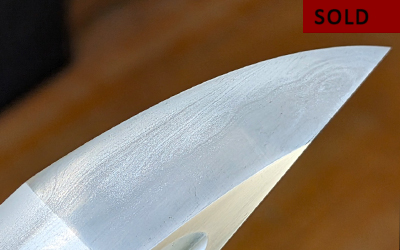
This sword is in immaculate condition, with an extremely healthy and beautiful jihada and all the hallmarks of Saburo Kunimune in its construction. The NBTHK stated that the condition is outstanding and that it is a remarkable masterpiece of the smith, very high praise indeed. Furthermore the work is of such high level that Tanobe Sensei drew a comparison to one of the Tokubetsu Juyo examples of this same smith in the sayagaki, which is the first time I’ve encountered such a statement in his sayagaki. The particular example he compares it to is pictured to the right. I think if you are to compare the oshigata with this naginata naoshi, you may find yourself in agreement with me that the hamon on this naginata naoshi is superior.
Horimono
On the sashi-omote side, there are faint traces of a slender hi seen along the upper half of the nakago.
Nakago
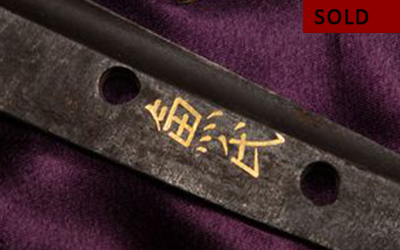
ō-suriage, kirijiri, sujikai-yasurime, one mekugi-ana, the sashi-omote side bears towards the nakago-mune a long kiritsuke-mei.
Setsumei
Bizen Kunimune belonged to the lineage of Naomune (直宗). He is famous since olden times under the nickname “Bizen Saburō” (備前三郎) as he was the third son (Japanese “Saburō”) of Naomune´s son Kunizane (国真). Later in his career he was invited by Hōjō Tokiyori (北条時頼, 1227-1263), the regent of the Kamakura-bakufu, and moved therefore to Kamakura where he and Sukezane (助真) from Bizen´s Fukuoka-Ichimonji school and Kunitsuna (国綱) from Kyōto´s Awataguchi school laid the foundation for the Sōshū tradition. So at least it is mentioned in various records. Anyway, there are relatively many works of him extant which range from wide and magnificent tachi with a flamboyant chōji-based hamon to rather slender and elegant tachi with a more calm suguha-based hamon. That means Bizen Saburō Kunimune was quite a diversified smith. A very peculiar feature especially of his interpretations in midare-ba are whitish spots (hajimi) in the ha which is also known since olden times and often described as “Bizen Saburō´s white stains.”
Here we have a naginata which was shortened and reworked into a katana. It has a wide and magnificent sugata and shows an itame mixed with mokume and a clearly visible midare-utsuri which is partially and towards the ha accompanied by a linear utsuri, i.e. results in a graduated dan-utsuri. The hamon is a ko-gunome mixed with ko-notare, ko-ashi and yō. The habuchi is rather tight and quite ko-nie-laden and some nijūba-like elements appear in places in the ha which resemble stripes. Also we see some cloudy parts along the nioi-guchi but which are thought to be intended and remnants of Kunimune´s characteristic feature, the hajimi. The condition of the blade outstanding and although ō-suriage, it is a remarkable masterpiece of Bizen Saburō Kunimune which shows all of his characteristics. And the fact that it was shortened by Osafune Sukesada who mentioned this via a kiritsuke-mei on the tang makes it atop of that an important reference.
Tanobe Sensei Sayagaki
Tanobe sensei seems to have enjoyed this sword. He wrote so much on this particularly long sayagaki that he ran out of room and had to put his signature on the opposite side. Please note the changes in color on the shirasaya are because it is an old shirasaya that needed to have its surface cleaned in order for the sayagaki to be laid down. The sayagaki was done at my request, so was performed very recently and the wood has not yet re-patinated. It will naturally darken in the cleaned areas with exposure to light and air and will have a uniform patina once again.
-
第四拾回重要刀剣指定品Dai yonjūkai jūyō-tōken shiteihinDesignated as jūyō-tōken at the 40th jūyō-shinsa
-
備前三郎国宗Bizen Saburō Kunimune
-
元来同工ノ在銘ナリシ薙刀ヲ室町期ニ長船祐定ガ磨上ゲタ旨切付銘有之Ganrai dōkō no zaimei narishi naginata o Muromachi-ki ni Osafune Sukesada ga suriage-ta mune kiritsuke-mei aru kore.This blade was once a signed naginata of that smith which was shortened in the Muromachi period by Osafune Sukesada but who added this information via a kiritsuke-mei.
-
同工ニハ丁子主調ノ華ヤカナ手ト直刃調ノ温和ナ作域デ青江気質ノ混在スル手ガ存在セリDōkō ni wa chōji shuchō no hanayaka na te to suguha-chō no onwa na sakuiki de Aoe-kishitsu no konzai suru te ga sonzai seri.Kunimune worked in a flamboyant chōji-based and in a gentle suguha-based hamon mixed with some Aoe characteristics.
-
本作ハ後者デ第拾回特重太刀ニ結バレル者ガアリ所傅ハ首肯サル出来宜敷ク味ワイ深矣Honsaku wa kōsha de dai jūkai tokubetsu-jūyō tachi ni musubareru mono ga ari shoden wa shukō saru deki-yoroshiku ajiwai fukai.This blade belongs to the latter category and matches very well a tachi of Kunimune which passed Tokubetsu Jūyō at the tenth shinsa.
-
出来宜敷ク味ワイ深矣Deki-yoroshiku ajiwai fukai.The deki is excellent and the work is very tasteful.
-
惟時甲午端月探山邉道追而識kore toki kanoto-uma tangetsu Tanzan Hendō tsui ni shirushite + kaōWritten by Tanzan Hendō (pseudonym of Tanobe Michihiro) in the first month of the year of the horse of this era (2014) + kaō